The Professional Guide to Construction Site Security Cameras in 2025
Construction site theft cost Australian builders over A$1.5 billion in 2025, a figure that continues to climb. You know the feeling. A missing excavator halts progress for days, unreliable 4G signals turn your live feed into a guessing game, and standard hardware often fails under the harsh Australian sun. It’s a constant battle against profit loss and project delays.
This guide is your blueprint for 2025. It's designed to help you master the technical, logistical, and legal requirements of deploying effective site monitoring equipment that protect your assets and streamline project management. We'll show you how to select systems that deliver crystal-clear footage from remote locations, capture evidence-grade video for insurance and police, and can be relocated seamlessly as your job site evolves from foundation to fit-out.
Key Takeaways
- Master the technical formula for 24/7 site visibility, detailing the essential solar, 4GX, and cloud setup required for off-grid Australian job sites.
- Evaluate the hire vs. buy decision with clarity and learn why a managed rental model (OPEX) protects you from high initial costs and the technology obsolescence trap.
- Implement a strategic surveillance layout to maximise loss prevention by identifying key choke points and optimising camera angles for total site awareness.
- Transform your site monitoring equipment from a cost centre into a profit driver by leveraging footage for remote management, safety audits, and powerful time-lapse marketing.
Why Traditional CCTV Fails on Modern Australian Construction Sites
A modern construction site is a dynamic, high-value environment. It’s also fundamentally hostile to traditional security systems. The old model of fixed cameras wired into a central recorder is obsolete before the first slab is even poured. Today’s professional construction site security cameras are not just cameras; they are ruggedized, autonomous surveillance ecosystems engineered to operate where nothing else can.
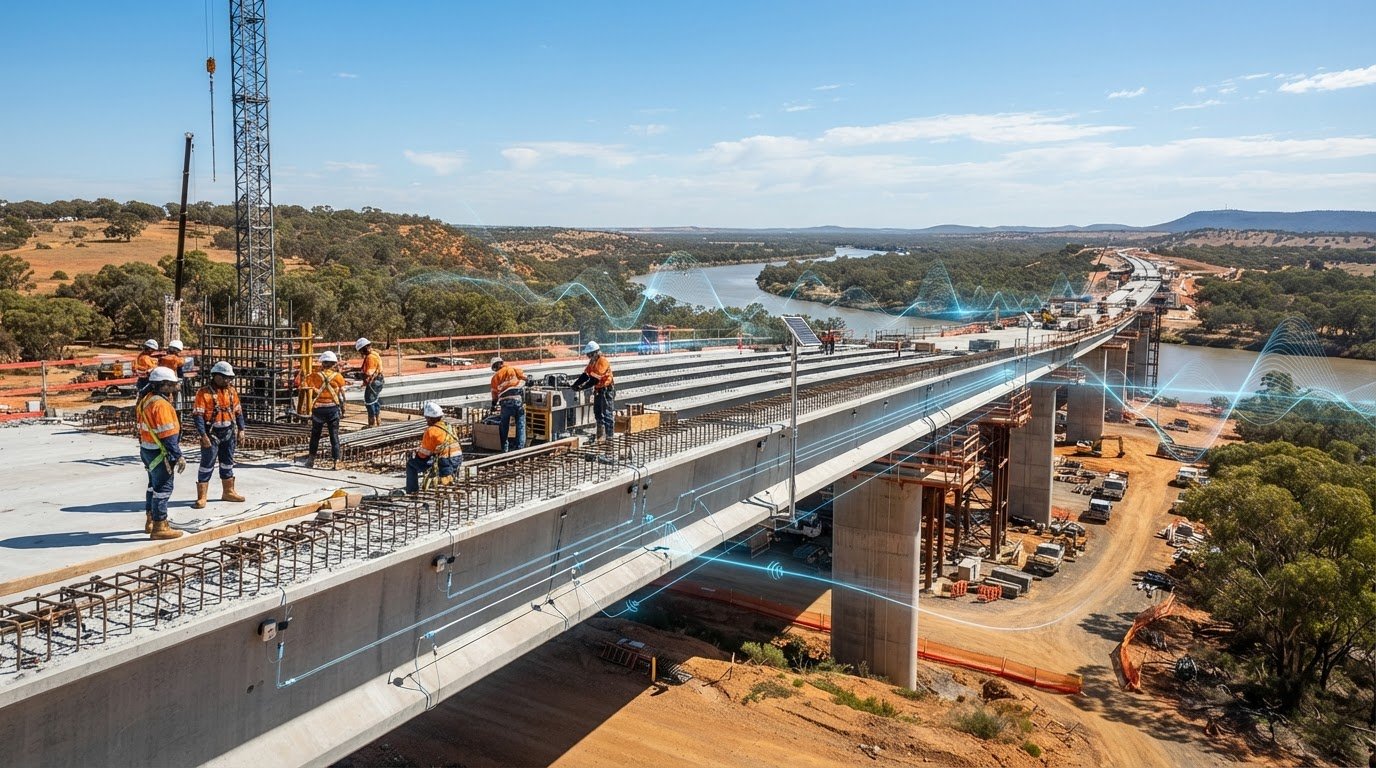
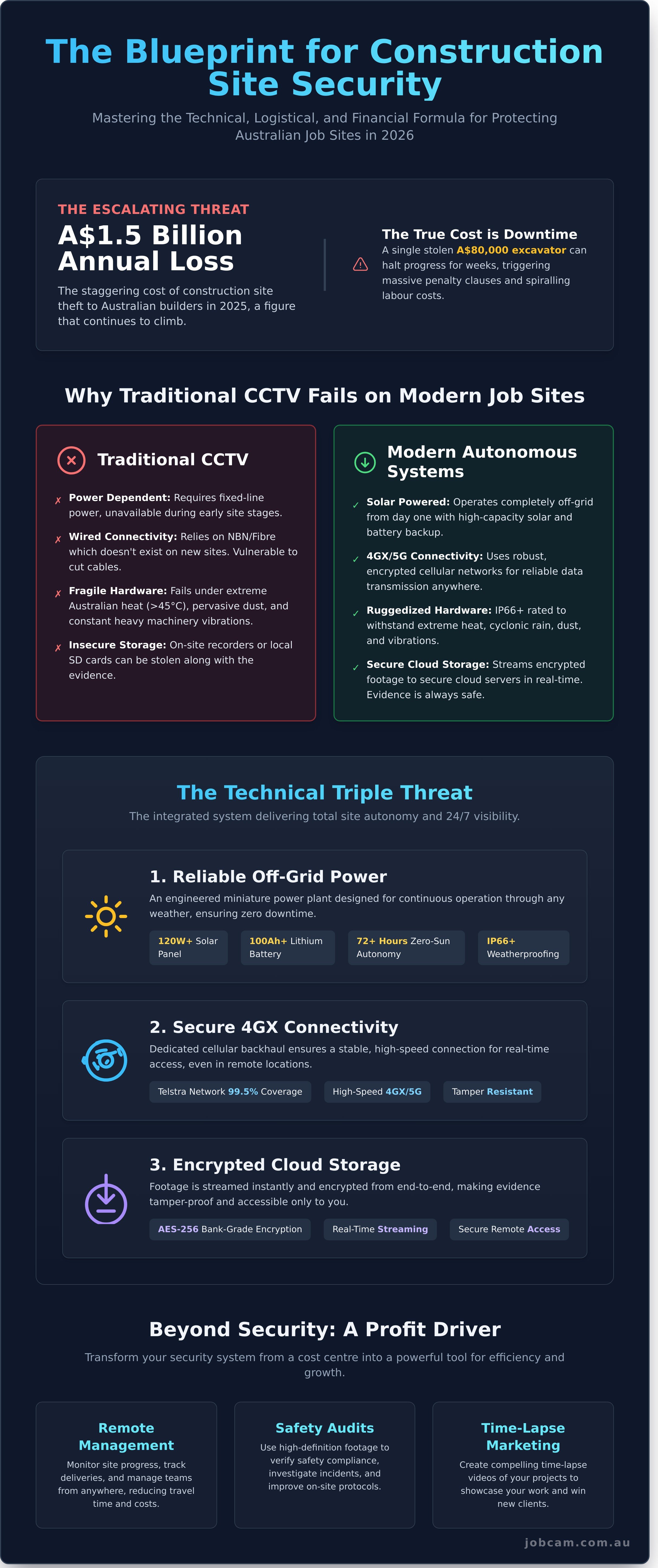
The primary hurdle is simple: new developments have no power and no internet. Early site works, civil engineering, and foundation stages happen completely off-grid. Traditional Closed-circuit television (CCTV) systems are dependent on fixed-line power and a stable NBN or fibre connection, infrastructure that won’t exist for months or even years. This creates a critical security gap. In contrast, modern mobile surveillance units operate independently. Powered by high-capacity solar panels and connected via industrial 4G and 5G networks, they provide high-definition oversight from day one.
Beyond connectivity, Australian sites present unique environmental stressors that destroy conventional hardware. Equipment must withstand:
- Extreme Heat: Sustained temperatures exceeding 45°C in Western Sydney or the Pilbara can cause system failure in non-specialised cameras.
- Pervasive Dust: Fine particulate matter from excavation and concrete work infiltrates and damages sensitive electronics in units without IP66 or higher ratings.
- Constant Vibration: The ground-shaking force of excavators, rollers, and heavy vehicles can disrupt connections and damage internal components of flimsy hardware.
The Limitations of Consumer-Grade Hardware
A smart home camera from a retail store is not a worksite solution. It lacks the durability, power autonomy, and secure connectivity required for an industrial environment. The biggest risk is data storage. A thief can simply steal a camera that records to a local SD card, taking all the evidence with them. Professional systems stream encrypted footage to secure cloud servers in real-time. Standard Wi-Fi is equally inadequate, offering limited range and unreliable connections, unlike industrial 4G that ensures constant uptime.
The Escalating Cost of Site Theft in 2025
Site theft in Australia now costs the industry hundreds of millions of dollars annually, but the equipment's sticker price is only part of the damage. The true cost is machinery downtime. A stolen A$80,000 excavator can halt progress for weeks, triggering penalty clauses and labour costs that spiral into hundreds of thousands of dollars. In response, insurers are now demanding 24/7 monitored surveillance as a prerequisite for coverage on high-value projects. This is where effective Loss Prevention comes in. In a construction context, Loss Prevention is the proactive strategy of using surveillance, monitoring, and site protocols to prevent the loss of assets and mitigate project delays before they occur.
The Technical Triple Threat: Solar, 4GX Connectivity, and Cloud Storage
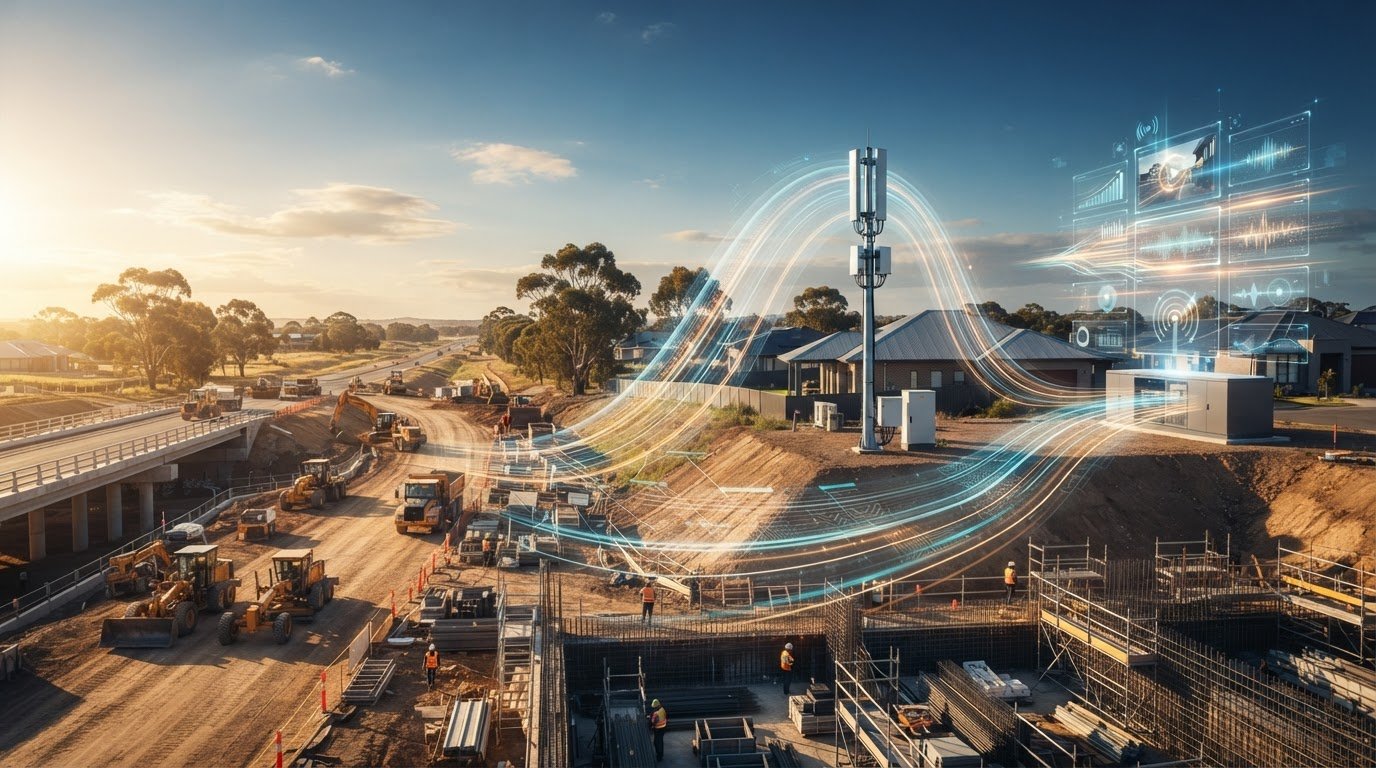
A modern construction site is a dynamic, off-grid environment. Traditional CCTV, with its reliance on fixed power and vulnerable on-site recorders, is fundamentally unsuited for the task. The professional standard for construction site security cameras in 2025 is built on a powerful synergy of three core technologies. This integrated system delivers total autonomy, providing constant visibility without depending on site infrastructure.
Reliable Power in Off-Grid Environments
Uptime is non-negotiable. A professional solar surveillance system isn't just a camera with a solar panel attached; it's an engineered power plant in miniature. The key is the power-to-battery ratio. A system with a 120W solar panel paired with a 100Ah lithium battery, managed by an intelligent Battery Management System (BMS), is designed to operate for over 72 hours with zero sunlight. This ensures continuous monitoring through extended periods of cloud cover or rain. For Australian conditions, weatherproofing is critical. Look for a minimum of an IP66 rating, which guarantees the hardware is completely dust-tight and can withstand powerful jets of water, protecting it from cyclonic rains and outback dust storms alike.
Connectivity and Data Security
Your footage is useless if you can't access it securely and in real-time. On-site Wi-Fi networks are easily jammed or can be disabled by cutting a single cable. That’s why a dedicated 4GX/5G cellular backhaul is essential. Leveraging the Telstra network, which covers over 99.5% of the Australian population, ensures a stable, high-speed connection even in remote and regional locations. This robust connection is protected by end-to-end AES-256 encryption, the same standard used by financial institutions. This secures data from the moment it's captured to the second you view it.
Crucially, all footage must adhere to the "Black Box" principle: it must live off-site. On-site recorders like NVRs or SD cards can be stolen or destroyed along with the assets they were meant to protect. With the annual cost of equipment theft in the construction industry climbing, storing evidence on-site is an unacceptable risk. An immediate, encrypted upload to the cloud makes your footage tamper-proof.
The final piece of this technical puzzle is a secure, scalable cloud storage platform. Amazon Web Services (AWS) is the undisputed gold standard, offering 99.999999999% data durability and geo-redundancy. This means your footage is replicated across multiple secure servers, protecting it from any single point of failure. This infrastructure moves security from a reactive to a proactive function. While historical playback is vital for incident reports, real-time alerts are what prevent losses. An integrated system uses its 4GX connection to send instant, AI-verified motion alerts to your device, allowing you to intervene in seconds, not hours. It’s the difference between documenting a theft and stopping it cold.
This triple-threat combination of solar power, cellular connectivity, and cloud storage creates a truly autonomous security asset. It’s a system that works for you 24/7, providing accountability and peace of mind. To see how these technologies are integrated into a single, deployable platform, you can explore turn-key surveillance solutions designed for Australian job sites.
Hire vs. Buy: Why the Managed Rental Model Dominates in 2025
The decision to secure your project isn’t just about choosing a camera; it’s about choosing a security strategy. For years, the default was to purchase hardware outright. This meant a significant capital expenditure (CAPEX) for an asset that starts depreciating the moment it’s installed. By 2025, this model is fundamentally broken. The industry has shifted to a managed rental model, converting security into a predictable, scalable operational expense (OPEX) that aligns with the fluid nature of modern Australian construction.
Buying hardware directly exposes your project to the "Obsolescence Trap." The pace of surveillance technology is relentless. A 4K camera purchased in 2024 is functionally outdated by 2025, surpassed by units with superior 5G connectivity, AI-driven threat detection, and advanced low-light performance. A managed rental service ensures your site is always equipped with current-generation technology. You gain access to the latest advancements without ever owning a depreciating asset. Your security capability evolves with the tech, not in spite of it.
This approach also delivers absolute clarity on your total cost of ownership. When you move beyond the sticker price of a camera, the financial case for buying collapses.
The Total Cost of Ownership (TCO) Analysis
Purchasing a high-definition, solar-powered camera system involves far more than the initial A$3,000+ hardware cost. You must account for professional installation (A$500-A$1,000), ongoing 4G or 5G data plans (A$70+ per month per unit), and cloud storage fees. The biggest financial risk, however, is maintenance. A single act of vandalism or a component failure can trigger an immediate A$1,500 replacement cost, derailing your project budget. With a managed rental, a single, fixed monthly fee covers the hardware, data, software, and complete maintenance support. There are no financial surprises.
Support and Accountability
When a camera goes offline at 2 AM, who is responsible? If you own the system, you are. This means dispatching your own team or finding an emergency technician. A managed service provider, however, assumes full accountability for system uptime. We monitor our entire network 24/7, proactively resolving issues before they become threats. This commitment to a 99.9% operational uptime isn’t just for peace of mind; it’s critical for meeting insurance policy requirements and demonstrating due diligence. A professionally installed system ensures optimal field of view (FoV), covering critical access points and blind spots, a key component in meeting WorkSafe Victoria's site security guidelines.
Ultimately, the debate is over. Buying these units in 2025 is a false economy that burdens your project with outdated tech and unpredictable costs. The managed rental model delivers superior technology, ironclad support, and budgetary control. It transforms security from a capital risk into a flexible, powerful service. Your focus is the build; we keep eyes on your site.
Strategic Implementation: Placement, Compliance, and Loss Prevention
The most advanced camera hardware is ineffective without a tactical deployment strategy. For construction site security cameras, this means precise placement, strict legal compliance, and seamless integration into your daily operations. This approach transforms a passive system into an active loss prevention and site management asset, giving you total control and accountability.
Your strategy must account for every vulnerability, from the perimeter to the core of your site. It’s about creating a comprehensive visual record that deters theft, validates work, and protects your bottom line.
Effective Camera Placement Strategies
Pinpointing your site's most critical zones is the foundation of an effective security plan. Your goal is to create overlapping fields of view that leave no blind spots where high-value assets are concerned. Focus your resources on three key areas:
- Entrance and Exit Monitoring: Your site's gates are the most critical "choke points." Position high-resolution cameras to capture a clear, time-stamped image of every vehicle's license plate upon entry and exit. This is your most valuable data point for investigating any incident.
- High-Value Asset Zones: The lay-down yard and fuel storage areas demand dedicated surveillance. According to a 2024 analysis by the Australian Institute of Criminology, tools, building materials, and fuel account for over 40% of all reported construction site theft. A fixed camera focused on these zones is non-negotiable.
- 360-Degree Site Oversight: For complete situational awareness, nothing beats a solar-powered surveillance tower. Placed centrally, its Pan-Tilt-Zoom (PTZ) camera provides an elevated, panoramic view of the entire project, allowing you to track machinery, monitor contractor activity, and respond to incidents in real-time.
With this strategic placement, your mobile app becomes a powerful command centre. A site manager can perform a virtual site walk, verify a delivery at the gate, or check on a specific work zone from anywhere, ensuring productivity and security are constantly monitored.
Legal Obligations and Signage
In Australia, workplace surveillance is governed by state and territory legislation, such as the Workplace Surveillance Act 2005 (NSW). The core principle is transparency. Covert surveillance is illegal and attracts severe penalties. You must provide all workers and subcontractors with a minimum of 14 days' written notice before any camera system is activated.
This legal duty extends to physical signage. Prominent "CCTV in Operation" signs must be installed at every site entrance. These signs must clearly state that surveillance is taking place and provide contact details for the entity responsible. This is not just best practice; it's a legal requirement that underpins a compliant security posture.
Finally, you must manage the captured data responsibly. Footage containing identifiable individuals is considered personal information under the Privacy Act 1988 (Cth). Access must be restricted to authorised personnel for legitimate purposes only. All video should be stored securely and deleted after a defined retention period, typically 30-60 days, unless required for an active investigation. A compliant, strategically planned system delivers both security and peace of mind. Let our experts help you design a robust and compliant security plan for your next project and ensure every angle is covered.
Beyond Security: Using Jobcam for Project Management and Marketing
In 2025, the most effective construction firms view their on-site technology as a profit centre, not a cost. Modern site monitoring equipment do more than just deter theft; they generate critical data that enhances project management, ensures compliance, and builds a powerful marketing engine. This is where the real return on investment is found. By shifting the perspective from simple surveillance to comprehensive site intelligence, you unlock a suite of tools designed to streamline operations and win future business.
The days of relying solely on site visits are over. A project manager in Sydney can now conduct a detailed virtual inspection of a site in Perth, saving the time and A$1,500+ cost of a cross-country flight. This isn't just about convenience. It's about proactive management. Using a high-definition live feed, you can remotely verify that safety protocols are being followed, confirming that temporary fencing is secure before a high-wind event, or that excavation shoring is correctly installed. This visual verification can be the key to avoiding stop-work orders or fines, which can exceed A$30,000 for serious breaches under Safe Work Australia regulations.
Accountability becomes absolute. Use live feeds to:
- Verify Material Deliveries: Get time-stamped visual confirmation that the 7:00 AM concrete pour arrived on schedule, eliminating costly disputes over supplier delays.
- Track Subcontractor Arrivals: Monitor the entry and exit of trades, ensuring labour is on-site as scheduled and billed hours match actual presence.
- Resolve Disputes Instantly: Access archived footage to clarify incidents, from minor equipment damage to sequencing conflicts between trades, providing irrefutable evidence.
Remote Management via the Jobcam App
Total site awareness is now in your pocket. The Jobcam app delivers on our central promise: See Your Site. From anywhere. Grant secure, tiered access to investors, clients, and key team members, providing complete transparency that builds trust and keeps stakeholders informed. Custom motion alerts can be configured to notify you of after-hours activity in specific zones, like a materials laydown area, ensuring you have immediate oversight 24/7.
Professional Time-Lapse Production
Your project has a story. We help you tell it. Jobcam transforms months or years of high-definition footage into a dynamic, professional time-lapse video. This isn't just a project record; it's your most powerful marketing asset. Showcase your capabilities to future clients, document your legacy for your portfolio, and celebrate your team’s achievement. By 2025, AI-enhanced editing, a trend commonly adopted in Australian construction tech, allows for automated milestone detection and cinematic-quality stabilisation, turning raw data into a compelling narrative that wins tenders.
Future-Proof Your Site: The Next Step in Construction Surveillance
The era of unreliable, wired CCTV on Australian job sites is officially over. In 2025, the industry standard is a fully managed hire solution. Today’s advanced site monitoring equipment rely on a technical triple threat: solar power, 4GX connectivity, and secure cloud storage. This approach moves beyond simple theft prevention, transforming your surveillance into an indispensable tool for project management, compliance, and stakeholder reporting.
Jobcam delivers this future-proof solution directly to your site. We leverage the power of the Telstra 4GX network and secure AWS cloud hosting to give you high-definition, real-time visibility. With professional installation and support available nationwide across Australia, our clients consistently reduce site theft and enhance project accountability from day one.
It's time to gain complete control. Secure your project with Jobcam’s solar surveillance hire and see your site from anywhere, anytime.
Build your next project with total confidence and clarity.
Frequently Asked Questions
Do construction site security cameras require a constant Wi-Fi connection?
No, they don't always require a constant Wi-Fi connection. Modern systems designed for remote sites use 4G or 5G cellular networks for reliable data transmission. This gives you real-time access to live feeds and alerts without depending on unavailable site Wi-Fi. These cameras also record locally, ensuring footage is captured even if the cellular connection temporarily drops, guaranteeing continuous surveillance and data integrity for your project.
How do solar-powered security cameras work during a week of rain?
Solar-powered cameras work through extended periods of rain by relying on high-capacity, integrated battery systems. A professional-grade solar unit is engineered with a battery reserve capable of powering the camera for 5-7 days without any direct sunlight. The panels are highly efficient, requiring only a few hours of daylight to fully recharge. This ensures your site remains under constant surveillance, regardless of prolonged overcast conditions or inclement weather.
What are the legal requirements for installing CCTV on a building site in Australia?
In Australia, you must comply with the Privacy Act 1988 (Cth) and relevant state surveillance laws when installing CCTV. The primary requirement is to provide clear and visible signage indicating that surveillance is in operation, informing all personnel and visitors they are being recorded. Cameras should never be placed in private areas like bathrooms or change rooms. Recording public areas of your site is permissible for a legitimate security purpose.
Can these cameras capture license plates clearly at night?
Yes, high-definition cameras with specialised night vision technology can capture license plates clearly at night. For reliable results, a system should feature a minimum 4MP resolution and advanced infrared (IR) illumination to overcome low light and headlight glare. For optimal capture, cameras should be positioned at the correct angle and height, typically within 15-20 metres of the target entry or exit point. This ensures you have clear, usable evidence of all vehicle movements.
Is it better to hire or buy security cameras for a 12-month project?
For a 12-month project, hiring is almost always the more cost-effective and practical solution. Hiring eliminates the large upfront capital outlay, which can exceed A$10,000 for a professional system. A hire agreement typically includes installation, maintenance, 24/7 technical support, and system removal upon project completion. This bundled service model provides the latest technology without the long-term responsibilities of ownership, like depreciation and storage.
How is the footage stored if the camera is stolen or vandalized?
Footage is securely stored off-site in the cloud, making it accessible even if the physical camera is compromised. Professional site monitoring equipment transmit footage in real-time to encrypted cloud servers. This means the critical moments leading up to an incident are already safe before the unit can be damaged. This immediate off-site backup is a non-negotiable feature, guaranteeing your evidence is protected and available for review or insurance claims.
What is the typical range of a mobile surveillance tower?
A typical mobile surveillance tower can effectively monitor an area with a radius of 80 to 120 metres. The exact range depends on the camera's lens, its resolution, and the tower's height, which is often adjustable up to 9 metres. High-resolution PTZ (Pan-Tilt-Zoom) cameras allow operators to focus on specific incidents within this range for detailed identification. On larger sites, multiple towers create overlapping fields of view, ensuring comprehensive coverage with no blind spots.
How quickly can a security camera system be installed on a new site?
A complete security camera system can typically be installed and fully operational within 24 to 48 hours. Mobile surveillance units are designed for rapid deployment because they don't require mains power or hardwired internet. A technician can deliver the unit, position it for optimal coverage, and activate the system quickly. This allows you to secure a new site from day one, protecting assets before major works even commence.