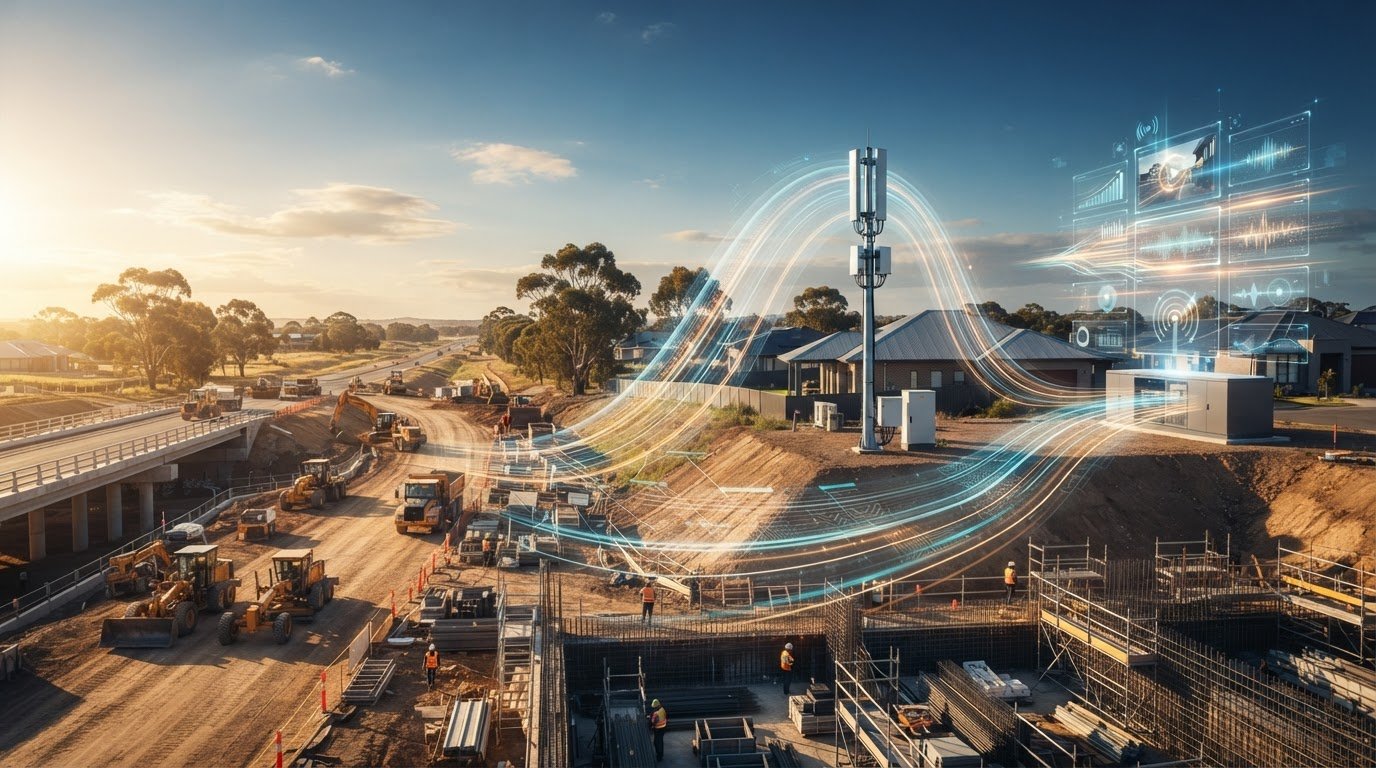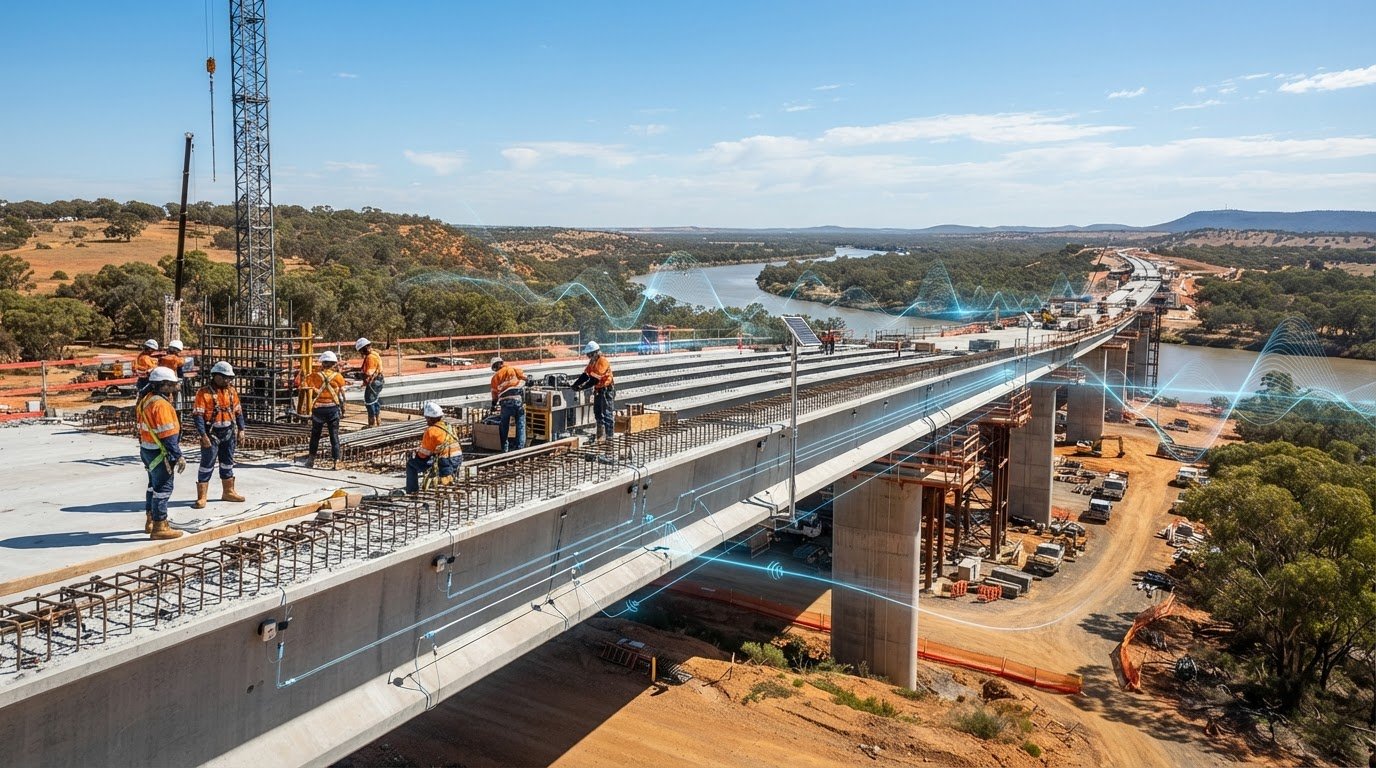

Building Site Surveillance Camera Guide: Securing Australian Projects in 2025
A single theft incident on an Australian construction site costs an average of A$2,500 in direct losses, but the project delay costs often triple that figure by the time replacement materials arrive. You already know that relying on budget hardware or a physical night watchman isn't a scalable solution for 2025. It's frustrating when an unverified camera cuts out during a 42-degree heatwave or loses its connection just as a critical delivery arrives. You need equipment that works as hard as your crew does.
This guide shows you how to integrate a professional building site surveillance camera system that uses high-efficiency solar power to provide 24/7 accountability. We'll show you how to achieve zero theft incidents while maintaining crystal-clear remote visibility directly from your smartphone. You'll also discover how to leverage automated time-lapse technology to streamline stakeholder reporting and showcase your project's legacy. We're breaking down the essential hardware specs and connectivity standards required to secure your perimeter and keep your timeline on track across any Australian postcode.
Key Takeaways
- Learn why traditional fencing is no longer sufficient to protect Australian projects and how to counter the rising financial impact of site theft.
- Identify the critical technical benchmarks, including solar autonomy and Telstra 4GX connectivity, required for a high-performance building site surveillance camera.
- Master strategic deployment techniques to eliminate dead zones and maintain total visibility as your project evolves from ground-breaking to lock-up.
- Evaluate the ROI of surveillance hire to access the latest 2025 AI technology while optimising your project’s operational expenditure.
- Discover how to leverage real-time monitoring and high-definition time-lapse to turn site accountability into a powerful stakeholder marketing tool.
The Evolution of Building Site Surveillance: Why Fencing Isn't Enough in 2025
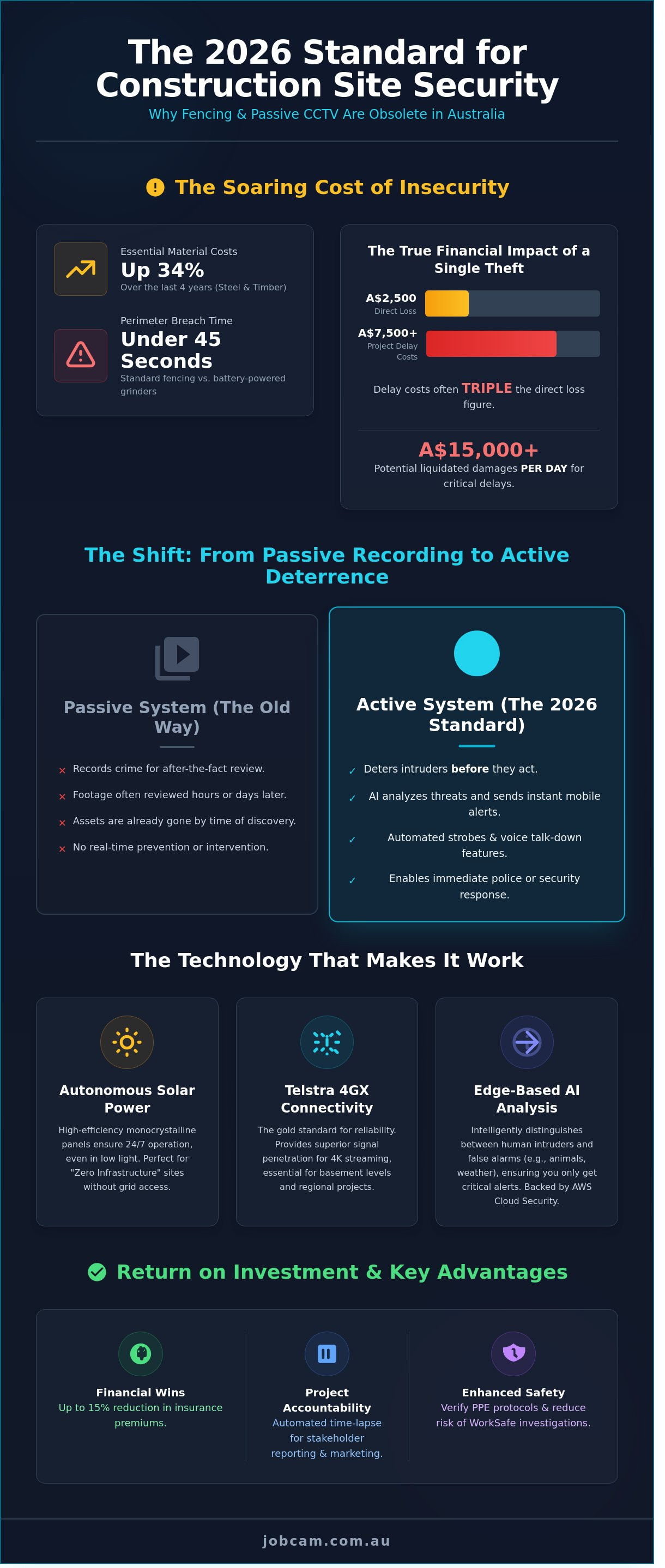
Australian construction sites are under unprecedented pressure in 2025. Data from the Australian Bureau of Statistics indicates that the cost of essential materials like structural steel and timber has surged by 34% over the last four years. These price hikes have transformed every pallet of copper piping and every stack of reinforced mesh into high-value liquid assets for organized theft rings. Relying on physical barriers is no longer a viable strategy. Temporary fencing is a 20th-century solution for a modern, sophisticated problem. Professional thieves now use battery-powered grinders to breach standard chain-link perimeters in under 45 seconds; to them, a fence is merely a minor hurdle rather than a deterrent.
Security has moved beyond the perimeter. While traditional Closed-circuit television (CCTV) focused on capturing footage for after-the-fact forensic analysis, the 2025 standard requires a proactive stance. Modern site security utilizes the building site surveillance camera as an active participant in site defense. These systems don't just watch; they analyze movement patterns using edge-based AI to distinguish between a wandering animal and a human intruder. This shift from passive recording to active deterrence is the only way to protect your margins in a high-cost environment.
Insurance providers have noticed this technological leap. In 2025, many Australian insurers offer up to a 15% reduction in premiums for sites that implement verified, AI-driven monitoring. This isn't just about theft. It's about safety compliance and liability. Having a high-definition site monitoring equipment allows project managers to verify that PPE protocols are followed and that heavy machinery exclusion zones are respected, reducing the risk of costly WorkSafe investigations.
The True Cost of Site Theft
The price tag of a stolen generator is only the beginning of the financial impact. Project managers must account for the A$2,500 insurance excess and the 12-week lead times currently affecting specialized electrical components. If a theft delays a concrete pour, the liquidated damages can easily exceed A$15,000 per day. Site shrinkage is the cumulative loss of small tools and materials over a project lifecycle. Beyond the hardware, 24/7 visibility creates a culture of accountability. When sub-contractors know the site is monitored in real-time, tool care improves and unauthorized after-hours access disappears. You can see your site from anywhere, ensuring that progress stays on track and assets remain secure.
Active vs. Passive Surveillance
Passive systems are designed to fail because they rely on someone watching a screen after the damage is done. By the time you review the footage on Monday morning, your copper is already at a scrapyard. Active surveillance changes the psychology of the encounter. High-tech surveillance towers equipped with blue-and-red strobes and automated voice talk-down features stop intruders before they touch your equipment. The sight of a solar-powered tower with 360-degree visibility sends a clear message: this site is a hard target. Integration with mobile apps means site managers receive instant, filtered alerts. You don't get a notification for a wind-blown tarp; you get a high-priority alert when a human enters the zone at 2:00 AM, allowing for an immediate police or security patrol response.
Technical Essentials: Solar Power, 4GX, and AWS Cloud Security
Remote construction sites rarely have established power grids during the first 12 weeks of development. This creates a "Zero Infrastructure" requirement where security systems must be entirely self-sufficient from day one. A modern building site surveillance camera must operate independently of the local grid to prevent downtime during early-stage excavation or utility cut-overs. We utilize high-efficiency monocrystalline solar panels to harvest energy, even in low-light conditions, ensuring your perimeter remains protected without a single meter of cabling.
Reliable uptime depends entirely on the strength of the cellular connection. In Australia, the Telstra 4GX network remains the gold standard for site security. It provides the necessary bandwidth for high-definition 4K streaming and rapid data bursts that standard 4G cannot match. While 5G coverage is expanding in metropolitan hubs like Sydney and Brisbane, 4GX offers the superior signal penetration required for basement levels and regional civil projects where newer frequencies often fail. This connectivity ensures that every motion-triggered event is transmitted to your device in under three seconds.
Battery technology has advanced to meet the specific challenges of the Australian climate. Modern lithium iron phosphate (LiFePO4) batteries provide 120+ hours of autonomy, meaning the system continues to record during five consecutive days of heavy overcast weather in Sydney or Melbourne. These units are designed for deep-cycle longevity; they don't degrade after a single winter season. This reliability gives project managers peace of mind that their site monitoring equipment won't go dark when the weather turns.
Solar Efficiency in the Australian Climate
Latitude dictates performance. A solar panel in Darwin requires a different tilt than one in Adelaide to capture maximum irradiance. We optimize every installation for the specific site coordinates to maximize winter sun harvest. On civil sites, dust is a persistent threat to power generation. Jobcam hardware utilizes specialized hydrophobic coatings on solar glass to mitigate this. These coatings reduce grit accumulation by 35% compared to standard glass, maintaining charge efficiency during high-activity earthworks. Managing power consumption is equally vital; our systems intelligently scale frame rates during low-activity periods to preserve energy for 24/7 live streaming when it's needed most.
Data Sovereignty and Cloud Integrity
Physical theft is a harsh reality on unmonitored sites. If a thief steals a camera that relies solely on internal SD card storage, your evidence is gone. We eliminate this single point of failure by using AWS (Amazon Web Services) Sydney regions to ensure every frame is stored off-site instantly. This approach aligns with Australian data privacy regulations and ensures low-latency access for local users. Recent research on real-time monitoring confirms that cloud-integrated IoT sensors significantly reduce response times during security breaches.
Data sovereignty isn't just a buzzword; it's a legal necessity for many government-contracted projects. By hosting data within Australian borders on AWS, we guarantee compliance and high-speed retrieval. Every stream is protected by AES-256 encryption, which secures your site's privacy without compromising the ability to see your site from anywhere. This combination of local hardware resilience and global cloud standards ensures that your project documentation remains intact, regardless of what happens to the physical camera on the ground.
Strategic Deployment: Maximising Coverage and Eliminating Dead Zones
Static security plans fail because construction sites are fluid. A blind spot today becomes a high-traffic zone tomorrow as the building envelope expands. Effective deployment requires a phase-based approach. You must move your cameras as the structure rises. Initial site works require perimeter focus, but once the first floor is poured, cameras should shift to monitor the building core and internal stairwells. This ensures your site monitoring equipment remains effective throughout the project lifecycle.
High-resolution monitoring at entry and exit points is non-negotiable. Data from 2024 shows that many successful recoveries involve clear footage of a vehicle's number plate or a driver's face. Place units at a height and angle that avoids glare from headlights while maintaining a direct line of sight to the cabin. Integrating these cameras with existing site lighting or temporary power poles reduces installation costs by 15% and ensures 24/7 visibility without the need for additional infrastructure.
Mapping Your Site for Surveillance
Effective mapping targets high-value zones first. Tool containers, copper storage areas, and diesel fuel tanks are the primary targets for theft, often holding over A$35,000 in assets in a single location. Don't leave these areas to a single lens. Use overlapping fields of view where one camera monitors the 'blind side' of another. This creates a fail-safe system where any attempt to tamper with a unit is captured by its neighbour. For standard 4K building site surveillance cameras, facial recognition clarity remains reliable up to 30 meters from the mounting point, ensuring identifiable evidence for police reports. Beyond this distance, cameras serve primarily for situational awareness and vehicle tracking.
Surveillance Towers vs. Fixed Point Cameras
Large-scale civil projects and sprawling residential developments require the 'High Ground' principle. A 6-meter mobile surveillance tower provides 360-degree oversight that fixed cameras on fences cannot match. These towers act as a visual deterrent and a central hub for site connectivity. They're essential for projects exceeding 2,000 square meters where cable runs are impractical. Mobility is the core advantage here. You can relocate these units in under 20 minutes as site boundaries shift or new access roads open. Managing 50 or more of these units becomes seamless through a single unified mobile app interface. This allows project managers to toggle between live feeds, check battery health on solar units, and review triggered alerts from any location in Australia. Visibility is accountability, and a unified interface ensures no corner of the site is left unmonitored.
Surveillance Hire vs. Purchase: Calculating ROI for Your Project
Choosing between purchasing hardware and opting for a managed service is a strategic financial decision. Buying a building site surveillance camera outright involves a significant upfront Capital Expenditure (CAPEX). This asset then sits on your balance sheet, depreciating over three to five years. In contrast, hiring shifts the cost to Operational Expenditure (OPEX). For Australian developers, this means the weekly hire fee is typically 100% tax-deductible as a direct project cost, keeping your cash flow liquid for materials and labour.
The "Obsolescence Trap" is a critical risk in 2025. Security technology now evolves at a rapid pace; AI-driven object detection and 8K sensor capabilities from 24 months ago are already outdated. If you own the fleet, you're stuck with legacy hardware that struggles to process modern analytics. Hiring ensures you always deploy the latest 2025-spec units. You get the benefit of improved low-light performance and smarter AI filtering without the burden of owning obsolete equipment.
Owning a fleet also introduces hidden costs. You're responsible for secure storage between projects, battery replacements, and firmware patches. A single faulty sensor can sideline a A$5,000 unit for weeks while you chase manufacturer warranties. With a hire model, these risks vanish. You pay for a result, not a piece of hardware. This scalability allows you to ramp up security during high-risk phases, such as the final 12 weeks of internal fit-out, and scale back once the project hits completion.
The Benefits of Managed Hire Services
Managed hire removes the technical burden from your site team. Professional technicians handle the initial commissioning, ensuring every site monitoring equipment is positioned for maximum coverage without blind spots. You receive ongoing technical support and remote firmware updates as part of the weekly rate. If the site layout changes, relocation services move your cameras quickly. This prevents your expensive site supervisors from wasting time acting as amateur IT support.
ROI: More Than Just Theft Prevention
True ROI extends far beyond stopping a break-in. A 2025 industry benchmark survey found that project managers save an average of 3.8 hours per week by using remote monitoring instead of making physical site visits for routine checks. At an average PM rate of A$120 per hour, this saves over A$450 weekly in labour alone. High-definition footage also serves as an indisputable record for dispute resolution. You can verify exactly when a concrete pour started or confirm if a sub-contractor was on-site for their claimed hours. Furthermore, many Australian insurers offer premium discounts of up to 15% for sites that maintain 24/7 monitored surveillance, directly padding your bottom line.
Stop managing hardware and start managing your project. Get a tailored hire quote for your next site today.
The Jobcam Advantage: Real-Time Monitoring and Time-Lapse Accountability
Effective site management in 2025 requires more than a passive recording device. Modern construction demands a proactive intelligence tool that bridges the gap between the physical site and the project office. A Jobcam building site surveillance camera functions as a high-definition window into your operations, providing a level of transparency that traditional security systems cannot match. We don't just provide hardware; we deliver a comprehensive visual management ecosystem designed for the rigours of Australian Tier 1 and Tier 2 projects.
The Jobcam App serves as the central nervous system for your entire project portfolio. It's a professional dashboard that allows stakeholders to toggle between sites in Perth, Sydney, Melbourne, and Brisbane with a single tap. This level of accessibility eliminates the "information silo" effect where site data stays trapped on-site. By the end of 2025, data showed that project managers using integrated visual dashboards reduced site-visit travel time by 22%, allowing them to focus on high-level scheduling and safety compliance instead of transit logistics.
Our commitment to Australian-wide reliability is backed by a robust infrastructure. From our Perth headquarters, we manage the technical heavy lifting, ensuring your footage is encrypted, stored, and accessible whenever you need it. We handle the logistics of deployment and maintenance so your team stays focused on the build. Learn how our app simplifies site management by providing a unified interface for every site monitoring equipment in your fleet.
Live Site Monitoring From Anywhere
Real-time visibility is the cornerstone of modern accountability. The Jobcam mobile app provides multi-user access with customisable permission levels, ensuring that the right people see the right data. Site foremen can use instant playback to review a delivery that occurred two hours ago, while executives can monitor progress across ten different postcodes simultaneously. Key features include:
- Custom Motion Alerts: Receive instant notifications for unauthorised after-hours movement.
- High-Definition Streaming: Crystal-clear visuals that allow for detailed inspection of formwork and reinforcement.
- Instant Archiving: Quickly save and share clips of specific site events for insurance or compliance records.
These tools empower project managers with real-time visual progress reports. Instead of relying on manual spreadsheets that might be 24 hours out of date, you see the physical reality of the slab pour or the crane lift as it happens. This immediate feedback loop is essential for maintaining the aggressive timelines typical of 2025 infrastructure projects.
Marketing Your Milestone
While security is the primary driver for installation, the secondary value of high-definition time-lapse is a significant competitive advantage. Jobcam processes raw security footage into professional-grade promotional videos that showcase your project's legacy. In 2025, many developers reported that high-quality time-lapse footage was a "critical component" of their successful tender submissions for future works.
Our systems capture images at precise intervals, which are then compiled into a cinematic narrative of the construction journey. This isn't just a record of work; it's a powerful branding asset. It allows you to demonstrate your team's capability to future clients, investors, and government stakeholders. We turn the grit of the job site into a polished story of engineering success, providing you with a marketing tool that works as hard as your crew does.
Future-Proof Your Australian Project Site
The Australian construction landscape in 2025 demands more than just perimeter fencing. Physical barriers fail to stop many site intrusions, making digital oversight a non-negotiable asset for any modern development. By integrating a high-performance building site surveillance camera, you gain 24/7 visibility powered by Telstra's 4GX network and secure AWS cloud storage. This infrastructure ensures your project remains protected against theft while providing the high-definition time-lapse data needed for transparent stakeholder reporting.
Australia's leading developers now prioritize solar-powered towers because they eliminate the need for fixed power lines, reducing onsite setup times by up to 48 hours. Whether you choose to hire for a specific 12-month build or purchase for long-term fleet management, the ROI is reflected in lower insurance premiums and total site accountability. Jobcam handles the heavy lifting with professional installation and ongoing maintenance included as standard. You're not just buying hardware; you're securing a tech-savvy partner that lets you see your site from anywhere. Secure your site today with Jobcam's solar-powered surveillance towers and build with total confidence.
Frequently Asked Questions
Do building site cameras need a Wi-Fi connection to work?
No, our building site surveillance camera systems don't require on-site Wi-Fi because they operate on dedicated 4G and 5G cellular networks. This ensures 99.9% uptime even on greenfield sites where infrastructure is non-existent. You get high-definition streaming and instant alerts without the instability of local routers. It's a plug-and-play solution that keeps your project visible from the moment the first fence goes up.
What happens to the surveillance footage if the camera is stolen or damaged?
Your footage remains secure because every frame is uploaded to encrypted cloud servers in real-time. If a unit is tampered with or stolen, the recorded data up to the point of impact is already stored safely off-site. We use 256-bit encryption to protect your project’s history. This allows you to identify intruders or review site incidents even if the hardware is physically compromised.
How much does it cost to hire a building site security camera per week in Australia?
Hiring a professional building site surveillance camera in Australia typically ranges from A$150 to A$350 per week. This price includes hardware rental, cellular data, and access to the monitoring platform. Costs vary based on your specific requirements, such as high-mast towers or 4K time-lapse capabilities. For a standard 12-month commercial build, budget approximately A$8,000 to A$15,000 for comprehensive 24/7 visual coverage and security.
Can solar-powered cameras work during a rainy week in Melbourne or Adelaide?
Yes, solar-powered cameras are engineered to function for 5 to 7 days without direct sunlight. We equip our units with 100Ah deep-cycle lithium batteries that charge even during overcast conditions in Melbourne or Adelaide. These systems harvest enough ambient light to maintain 100% functionality throughout the winter months. You won't lose visibility during a week of southern rain; the technology is built for Australian climates.
Are there legal requirements for signage when using CCTV on a construction site?
Australian law, including the Privacy Act 1988, requires clear signage at every site entrance where CCTV is active. These signs must be visible to everyone entering the area and state that surveillance is in progress for security purposes. Proper signage isn't just a legal checkbox; it acts as a primary deterrent. It reduces unauthorized entry by many according to industry security audits conducted in 2023.
How quickly can a surveillance camera be installed on my site?
We can typically have a system operational on your site within 24 to 48 hours of your request. Our technicians handle the entire setup, from mounting the hardware to configuring the software interface. Because the units are self-contained and pre-configured, physical installation often takes less than 60 minutes. This speed allows you to secure a site immediately after a risk assessment or a new project launch.
Can I monitor multiple construction sites from a single app?
You can monitor an unlimited number of construction sites through a single, centralized dashboard on our app. This feature allows project managers to toggle between projects in Sydney, Brisbane, and Perth in seconds. It provides a holistic view of your entire portfolio, ensuring accountability across all locations. You’ll see your site from anywhere, whether you're managing two local builds or 20 national developments.
What is the difference between a standard security camera and a surveillance tower?
A standard camera is a fixed unit mounted to existing structures, while a surveillance tower is a mobile, 6-meter tall autonomous platform. Towers offer a 360-degree vantage point and include integrated solar panels, sirens, and strobe lights. They’re ideal for large-scale civil projects where no mounting points exist. Standard units are better for tight urban sites where space is at a premium but high-resolution monitoring is still vital.