
Developing a Robust Job Site Security Plan for 2026: A Practical Guide
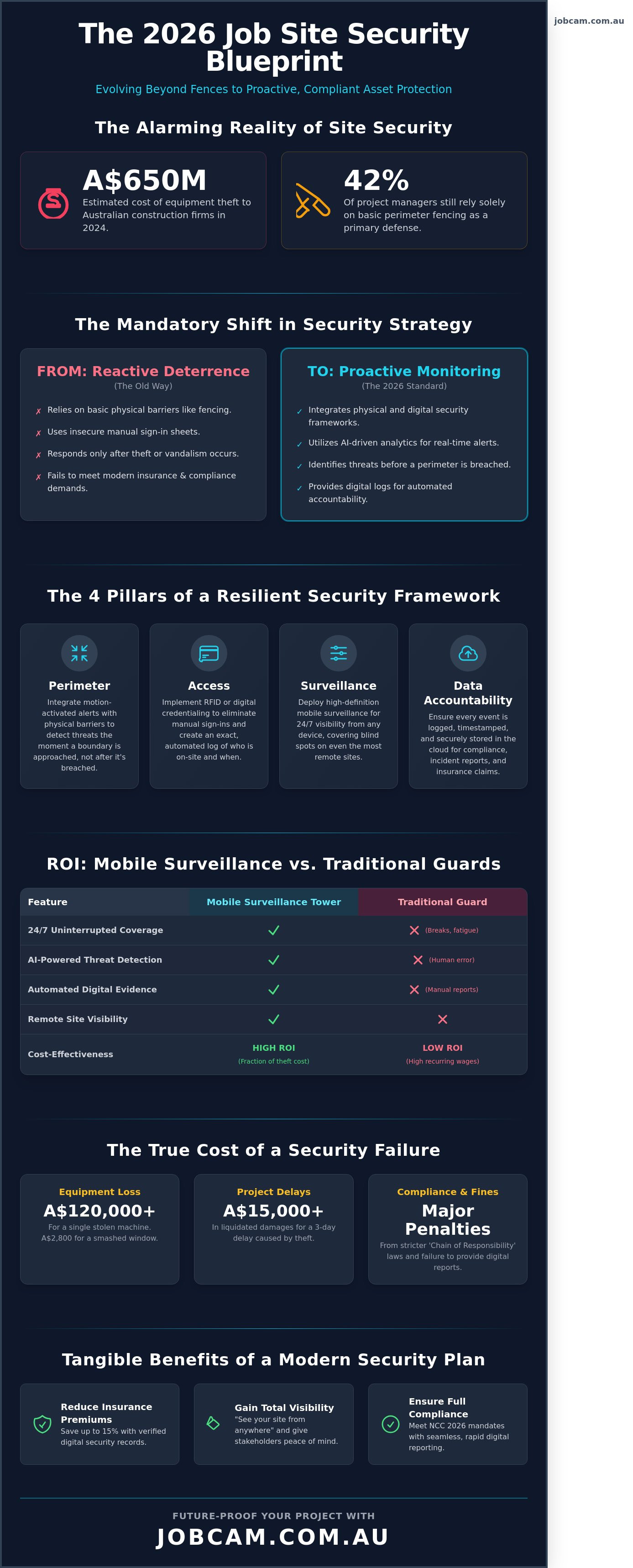
Equipment theft cost Australian construction firms an estimated A$650 million in 2024, yet 42% of project managers still rely on basic perimeter fencing as their primary defense. As we move toward a more demanding era of development, your job site security plan 2026 must evolve beyond simple physical barriers. You already know that managing a remote site without permanent power isn't an excuse for blind spots anymore. Rising equipment costs and tightening Australian safety standards mean a reactive approach will only lead to expensive downtime and heavy compliance fines.
We agree that the pressure to maintain zero-loss operations while juggling complex regulatory demands is at an all-time high. This guide provides the practical blueprint to master the 2026 landscape, ensuring you protect every asset with high-definition, real-time visibility from any device. We'll explore the specific technology trends and legislative shifts you need to build a resilient, autonomous, and fully compliant security framework for your next project.
Key Takeaways
- Shift from reactive deterrence to proactive, real-time monitoring with an integrated digital and physical security framework.
- Master the four essential pillars—Perimeter, Access, Surveillance, and Data Accountability—to build a compliant job site security plan 2026.
- Evaluate the superior ROI of mobile surveillance towers versus traditional physical guards to protect your project’s bottom line.
- Learn how to conduct site-specific risk assessments and map surveillance blind spots using your project’s unique site plans and timelines.
- Leverage high-definition visibility to see your site from anywhere, providing stakeholders with total transparency and peace of mind.
The 2026 Job Site Security Landscape: Why Your Plan Needs an Upgrade
A job site security plan 2026 isn't a static document stored in a site office; it's a live, integrated framework that merges physical barriers with high-definition digital oversight. The industry has moved beyond reactive deterrence. You can't afford to wait for a Monday morning discovery of missing copper or vandalised machinery. Modern plans prioritise proactive, real-time monitoring that identifies threats before a perimeter is even breached. This evolution aligns security directly with Construction Site Safety Principles, where managing site access is as critical to hazard control as it is to asset protection.
Proactive monitoring utilizes AI-driven analytics to distinguish between a stray animal and a genuine intruder. By 2026, the merging of Work Health and Safety (WHS) mandates with security oversight is complete. Security cameras now pull double duty, ensuring workers wear correct PPE while simultaneously tracking site deliveries. This transparency provides project managers with quiet confidence, knowing that every movement on-site is captured and archived for compliance and progress tracking.
Traditional lock and key methods are no longer sufficient for modern Australian insurance requirements. Insurers now demand more than a sturdy gate; they require digital logs and visual verification. Relying solely on physical locks often leads to claim denials if there's no evidence of forced entry or proof of active surveillance. A robust plan ensures your site remains a controlled environment where visibility is constant and accountability is automated.
Regulatory Shifts and Compliance in 2026
The Australian National Safety Blueprint for 2026 has introduced stricter site oversight goals. These regulations focus on the "Chain of Responsibility," making site owners and contractors equally liable for security lapses. Updates to the NCC 2025 and 2026 frameworks have placed a higher premium on digital site documentation. You're now required to provide digital evidence for incident reporting within a 24-hour window. Seamless cloud-based storage is the only way to meet these accelerated timelines without disrupting project momentum.
The Real Cost of Security Failures
The financial impact of a security breach extends far beyond the price of a stolen tool. Consider the current 2026 market rates for equipment and delays:
- Equipment Replacement: Replacing a smashed excavator window costs roughly A$2,800, while a total machine theft can exceed A$120,000.
- Surveillance Hire: Professional surveillance hire typically costs between A$1,500 and A$3,000 per month, representing a fraction of the cost of a single major theft.
- Hidden Delay Costs: A three-day delay caused by stolen electrical cables can cost a medium-scale project upwards of A$15,000 in liquidated damages and idle labour.
In 2026, site accountability is the verified digital record of every person and vehicle entering a project, serving as the primary lever for reducing annual insurance premiums by up to 15%; this accountability is further strengthened when paired with expert traffic management services South East Queensland to oversee physical site access.
Core Pillars of a Comprehensive 2026 Site Security Strategy
A robust job site security plan 2026 rests on four critical pillars: Perimeter, Access, Surveillance, and Data Accountability. This framework moves past the traditional lock and key era. It focuses on a "see your site from anywhere" philosophy. For stakeholders, this means 24/7 visibility is no longer a luxury. It's a standard requirement. Whether your project is in the heart of Sydney or a remote corner of the Pilbara, you need eyes on the ground. Power outages or lack of fixed infrastructure shouldn't create blind spots. Visual verification allows project managers to confirm site status instantly, reducing the need for costly, time-consuming site visits.
Effective planning starts with assessing jobsite security risks to identify where technology can bridge the gap between physical barriers and real-time awareness. Data accountability ensures every event is logged, timestamped, and accessible for future audits or insurance claims.
Perimeter and Access Control
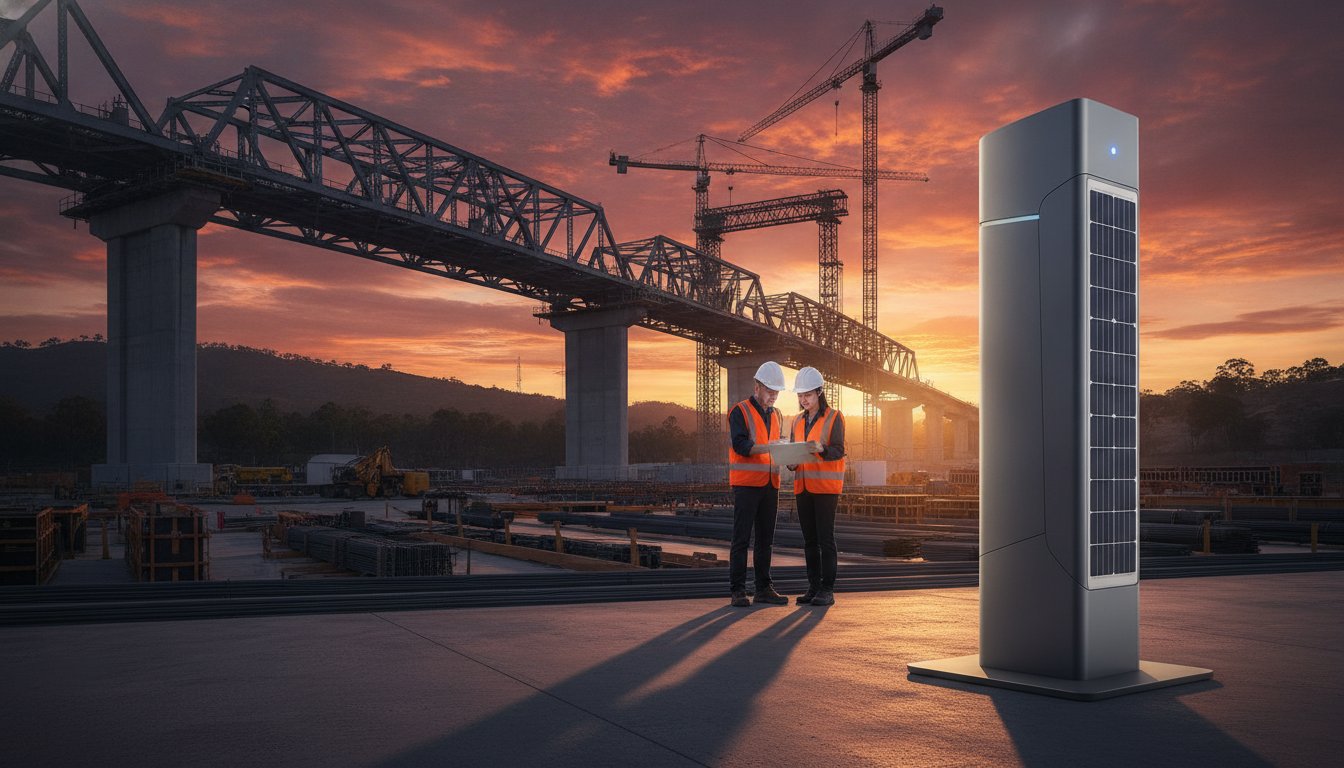
Temporary fencing is a baseline, not a solution. In 2026, perimeter security integrates motion-activated alerts that trigger the moment a boundary is breached. Modern site access management relies on RFID credentialing. This system tracks exactly who is on-site and when they arrived. It eliminates the guesswork of manual sign-in sheets. Surveillance towers provide a physical presence that fencing cannot match. These towers act as a psychological deterrent. They signal to potential intruders that the site is actively monitored. When combined with visual verification tools, these systems ensure that only authorised personnel move through your gates.
Surveillance and Real-Time Monitoring
Evaluating Technology: Surveillance Towers vs. Traditional Methods
Choosing the right hardware is a cornerstone of any effective job site security plan 2026. Traditional security often relies on physical guards, but the ROI is increasingly difficult to justify. A static guard presence can cost a project upwards of A$12,000 per month for basic night coverage. In contrast, mobile surveillance towers provide 24/7 monitoring at roughly 20% to 30% of that cost. They don't require breaks; they don't have blind spots; and they provide a high-definition record of every movement on site.
Early-stage projects face a unique hurdle: lack of permanent power. Traditional CCTV systems require hardwired infrastructure that simply isn't available during the civil or excavation phases. Mobile towers solve this by operating independently. As site boundaries shift during construction, these units move with the work. You can't relocate a wired camera system in an afternoon, but you can reposition a trailer-mounted tower in minutes to cover new high-value assets or entry points.
Data integrity is another critical shift for 2026. On-site NVR (Network Video Recorder) systems are vulnerable to theft, fire, or tampering. If a criminal steals the recorder, your evidence is gone. Modern systems bypass this risk by streaming encrypted footage directly to AWS cloud servers. This ensures that even if the hardware is destroyed, the footage remains accessible for police reports and insurance claims. It's a layer of redundancy that traditional systems can't match.
The Advantages of Solar-Powered Surveillance
The Australian climate provides the perfect environment for solar-powered security. These units leverage high-efficiency panels to maintain 100% uptime, even during overcast periods in Melbourne or Sydney. By utilizing 4GX connectivity, they transmit real-time alerts without needing a local Wi-Fi network. This setup eliminates the need for diesel generators. Removing generators eliminates fuel costs, refueling labor, and noise complaints from neighboring properties. It's a cleaner, quieter, and more reliable way to maintain site visibility.
Hire vs. Buy: Why Rental Wins in 2026
Technology cycles are shrinking. Buying security hardware in 2026 often means owning obsolete equipment by 2028. Choosing a solar powered security camera rental allows project managers to treat security as a scalable operational expense (OpEx) rather than a heavy capital investment (CapEx). Professional rental services include installation, remote technical support, and relocation as the site evolves. You get the latest 4K sensors and AI analytics without the burden of maintenance or long-term storage of bulky equipment between projects. It's the most logical choice for a flexible job site security plan 2026.
How to Implement Your 2026 Site Security Plan
Implementation converts a theoretical strategy into a functional shield for your assets. A successful job site security plan 2026 requires a five-step execution framework that adapts to the physical changes of your project. Start by conducting a site-specific risk assessment. Don't rely on generic templates; focus on high-value zones such as tool containers and fuel tanks. Position surveillance towers at a height of 6 to 8 metres to maximise coverage while preventing equipment tampering.
Strategic lighting is your first line of physical defence. Data from the Australian Institute of Criminology indicates that high-intensity site lighting can reduce theft and vandalism by 20% by increasing the perceived risk of detection. Map your surveillance blind spots using current site plans and projected timelines. This ensures that as structures rise, your cameras aren't staring at a concrete wall. You must also establish a data retention policy that complies with the Privacy Act 1988. Most Australian projects require a minimum 30-day storage window to facilitate incident investigations and insurance claims.
Step-by-Step Risk Assessment
Identify your "red zones" where high-value assets like copper cabling or heavy machinery congregate. Australian construction theft costs the industry approximately A$650 million every year, making these zones critical. Position JobCam units to cover these areas with overlapping fields of view. High-definition optics ensure you can read number plates at the gate even in low light. Don't set and forget your hardware. As the building footprint evolves, move your cameras to maintain visibility across the entire site perimeter.
Integrating Surveillance with Project Reporting
Modern security tools serve a dual purpose. Use time-lapse video feeds to provide stakeholders with real-time progress updates without requiring them to visit the site. The Jobcam Mobile App facilitates instant visual verification, allowing foremen to check deliveries or site conditions from their smartphones. This transparency builds trust and accountability across the workforce. Train your site team to access recorded footage quickly. When an incident occurs, the ability to export high-definition evidence within minutes is vital for a swift resolution. Integrating these feeds into your job site security plan 2026 ensures that security becomes a seamless part of your daily project management workflow.
Future-Proofing Your Project with Jobcam Surveillance
Jobcam acts as a silent, expert extension of your construction team. We don't just provide cameras; we offer a tech-savvy partnership that scales with your national operations. Transparency is the core of our service. By providing constant visibility, we help project managers maintain control over every square metre of the site. This level of oversight is essential when developing a job site security plan 2026 that prioritises accountability and risk mitigation. Our approach ensures that stakeholders stay informed through high-definition visual data that's accessible 24/7.
Why National Projects Choose Jobcam
Australian construction sites face unique environmental and logistical hurdles. We solve these through the reliability of Telstra 4GX connectivity. This ensures your feed stays live across the entire country, regardless of local infrastructure gaps. Security also means protecting your evidence. Traditional on-site hardware is vulnerable to theft or damage. We use AWS cloud hosting to prevent data loss. Even if physical equipment is compromised, your high-definition records remain accessible in the cloud. Our commitment to organization-wide reliability means your security data is redundant, encrypted, and ready for audit at any moment. This eliminates the 15% to 20% data loss risk often associated with local DVR systems.
Get Started with Your 2026 Security Upgrade
A robust job site security plan 2026 requires equipment that's easy to deploy and even easier to manage. Our project-based hire model removes the burden of ownership and maintenance. We manage the professional setup and the final decommissioning once the project hits completion. This seamless transition allows your team to stay focused on the build rather than troubleshooting hardware. We've streamlined the process so that a new site can be fully monitored within 48 to 72 hours of a request.
Don't view surveillance as a sunk cost. Use our high-definition time-lapse capabilities to document your project's legacy. These visual assets are perfect for stakeholder reporting and high-impact marketing. You're not just protecting a site; you're capturing its progress for future tenders and brand building. To see how we can secure your next development, request a professional site security consultation. It's time to see your site from anywhere with total confidence and professional support.
Future-Proof Your Assets with Smarter Site Oversight
Building a robust job site security plan 2026 requires moving beyond basic fencing and static guards. You need a system that integrates 24/7 solar-powered reliability with high-speed Telstra 4GX connectivity and secure AWS Cloud storage. This ensures every corner of your Australian construction site remains visible from any location, day or night. By deploying autonomous surveillance towers, you can reduce manual oversight costs by up to 25% while maintaining a high-definition record of project progress. Professional project management in 2026 demands this level of transparency and accountability. Jobcam provides a national Australia-wide service that keeps your assets protected and your stakeholders informed. Our systems are built for the harsh Australian climate, ensuring zero downtime regardless of site conditions. It’s time to stop worrying about site vulnerabilities and start focusing on your project’s delivery. We’ll help you keep your timeline on track and your site secure. Your team deserves the peace of mind that comes with total visibility and reliable, real-time data.
See your site from anywhere; Explore Jobcam Hire Solutions
Frequently Asked Questions
What are the mandatory job site security requirements in Australia for 2026?
Mandatory requirements for a job site security plan 2026 include perimeter fencing at a minimum height of 1.8 metres and documented access logs for all personnel. Safe Work Australia's 2026 standards mandate that high-risk sites must implement 24/7 visual surveillance to mitigate unauthorized entry risks. Compliance helps your firm avoid fines that can exceed A$50,000 for non-compliant Tier 1 projects.
Can solar security cameras work during extended periods of rain or low light?
JobCam's solar systems operate for 5 consecutive days without direct sunlight using 100Ah lithium-ion batteries. These units charge even during overcast conditions in cities like Melbourne or Hobart. High-efficiency monocrystalline panels ensure the system remains active through the winter months. You won't lose visibility during a week of heavy rain because the hardware stores ample backup power.
How does cloud storage protect footage if the camera is stolen or damaged?
Cloud storage protects your data by instantly transmitting footage to a secure remote server the moment it's captured. If a thief steals or destroys the physical camera, the recorded evidence is already safe in the cloud. We use 256-bit encryption to secure this data. You can download the 4K footage of the incident from any device to provide to the police.
Is a security plan required for insurance coverage on construction sites?
Most Australian insurers require a formal job site security plan 2026 before they'll issue a policy for projects valued over A$2 million. Implementing a documented strategy can reduce your annual premiums by 10% to 15% depending on your provider. Without 24/7 monitoring and a clear response protocol, many insurance companies will deny claims related to plant theft or site vandalism.
How often should mobile surveillance towers be relocated during a project?
Relocate mobile towers every 4 to 8 weeks as your site topography shifts and new blind spots emerge. During the structural phase of a 20-storey development, you'll need to move units to maintain a clear line of sight over high-value material storage areas. Regular repositioning ensures your 360-degree coverage remains effective as the building footprint expands and changes shape.
What is the difference between a surveillance tower and a standard site camera?
The primary difference is the 6-metre telescopic mast and self-contained power supply found on a surveillance tower. While a standard camera mounts to a fixed structure, a tower is mobile and provides a bird's-eye view of an entire 5,000 square metre site. Towers include integrated solar arrays and high-gain 4G antennas for reliable connectivity in remote Australian locations.
How do I access live footage from my phone using the JobCam app?
Accessing live footage is a simple three-step process through the JobCam app on your smartphone. Log in with your secure credentials, select your project from the dashboard, and tap the Live View icon. You'll see high-definition video with less than 2 seconds of latency. This allows you to monitor site progress or verify deliveries from anywhere in the world.
Are there legal restrictions on using CCTV on Australian building sites?
Australian law requires you to display clear signage at every entry point notifying workers and visitors that CCTV is in operation. Under the Privacy Act 1988, you must ensure cameras don't record private residential areas adjacent to your site. Most states also prohibit recording in staff changing rooms or toilets. Compliance protects you from legal disputes and potential A$10,000 privacy breach fines.