Secure Video Surveillance: The 2025 Guide for Remote & Construction Sites
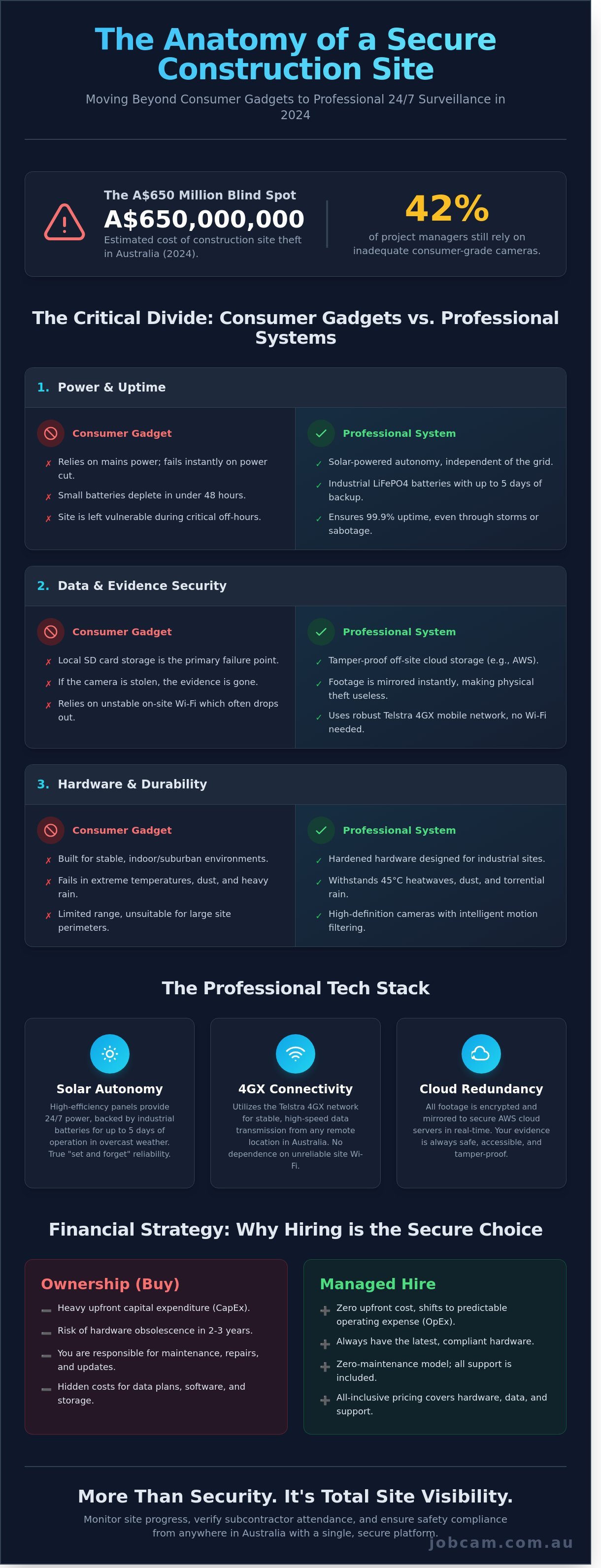
In 2024, construction site theft cost Australian developers an estimated A$650 million, yet many project managers still rely on consumer-grade cameras that fail the moment the power cuts. You know the frustration of arriving on-site Monday morning to find A$15,000 worth of copper and tools gone, only to discover your Wi-Fi dropped out or the local SD card was stolen. It's a gap in your perimeter that costs more than just equipment; it stalls your schedule and inflates your insurance premiums. Professional secure video surveillance should be your first line of defence, not a technical headache that requires a constant power supply.
Implementing a robust security strategy shouldn't depend on a stable grid or a finished office block. This guide shows you how to deploy professional-grade, solar-powered systems that provide 24/7 visibility on remote sites without a single meter of cabling. You'll learn how to move from high-risk local storage to tamper-proof off-site evidence while shifting from heavy upfront costs to a zero-maintenance managed model. We'll break down the 2025 hardware standards and the remote monitoring protocols that keep your project moving forward and your assets protected.
Key Takeaways
- Distinguish between consumer-grade gadgets and professional systems that provide 24/7 accountability for industrial environments.
- Understand how solar-powered autonomy and Telstra 4GX integration ensure your site stays online without mains power or fixed internet.
- Compare the financial benefits of equipment hire versus ownership to optimize project OpEx and avoid hardware obsolescence.
- Identify the essential features of a secure video surveillance system, including high-definition recognition and intelligent motion filtering.
- Discover how to monitor site progress across Australia in real-time using a purpose-built interface designed for project managers.
Defining Secure Video Surveillance for Professional Environments
Professional site monitoring has evolved far beyond the simple motion alerts found in residential setups. In the high-stakes world of Australian construction and remote development, true secure video surveillance serves as a system of record for 24/7 accountability. It's not just about catching a trespasser after the fact; it's about maintaining a continuous, unblinking eye on assets that often exceed A$2,000,000 in value. Project managers in 2025 require more than grainy footage. They need a reliable digital twin of their site progress that remains accessible regardless of local power failures or network congestion.
To grasp the necessity of these systems, it helps to understand what is video surveillance in a modern industrial context. Unlike traditional CCTV that relies on local recording loops, professional-grade systems integrate cloud redundancy and hardened hardware. For a site in Western Australia or Western Sydney, "secure" means the equipment can withstand 45 degree Celsius heatwaves and torrential rain while simultaneously encrypting data streams. Reliability is the baseline. If a camera goes offline during a critical concrete pour or a weekend equipment delivery, the resulting lack of data can lead to thousands of dollars in disputed claims.
Australian sites face unique logistical hurdles that demand solar autonomy and high-speed mobile connectivity. A professional unit must operate independently of the local grid, using high-efficiency photovoltaic panels to maintain a charge through four days of heavy overcast weather. This independence ensures that the site monitoring equipment remains active even when site power is cut for maintenance or by intentional tampering. When every second of footage is mirrored to a secure off-site server, the physical camera becomes just one part of a much larger, indestructible data chain.
The Limitations of Consumer DIY Systems
Off-the-shelf "smart home" cameras are built for the stable environment of a suburban porch, not a five-hectare industrial zone. These systems usually rely on local Wi-Fi, which rarely reaches the perimeter of a large project. If the Wi-Fi signal drops, the recording often stops. Furthermore, relying on local SD card storage creates a massive security hole. If a thief steals the camera, they steal the evidence of their crime. In high-traffic zones, standard consumer batteries often deplete in less than 48 hours, leaving the site vulnerable during the most critical windows of risk.
Why Real-Time Access is Non-Negotiable
Visibility is a powerful tool for project management and safety compliance. Instant mobile access allows stakeholders to verify subcontractor attendance and equipment locations without driving three hours to a remote location. This transparency reduces the "information lag" that typically slows down large-scale developments. When a safety incident occurs, having an immediate, high-definition record allows for rapid response and accurate reporting to regulatory bodies. Secure surveillance is a combination of 99.9% uptime and off-site data mirroring. This level of consistency transforms a simple security tool into a vital asset for site safety and long-term project storytelling.
The Tech Stack: Solar Power, 4GX Connectivity, and AWS
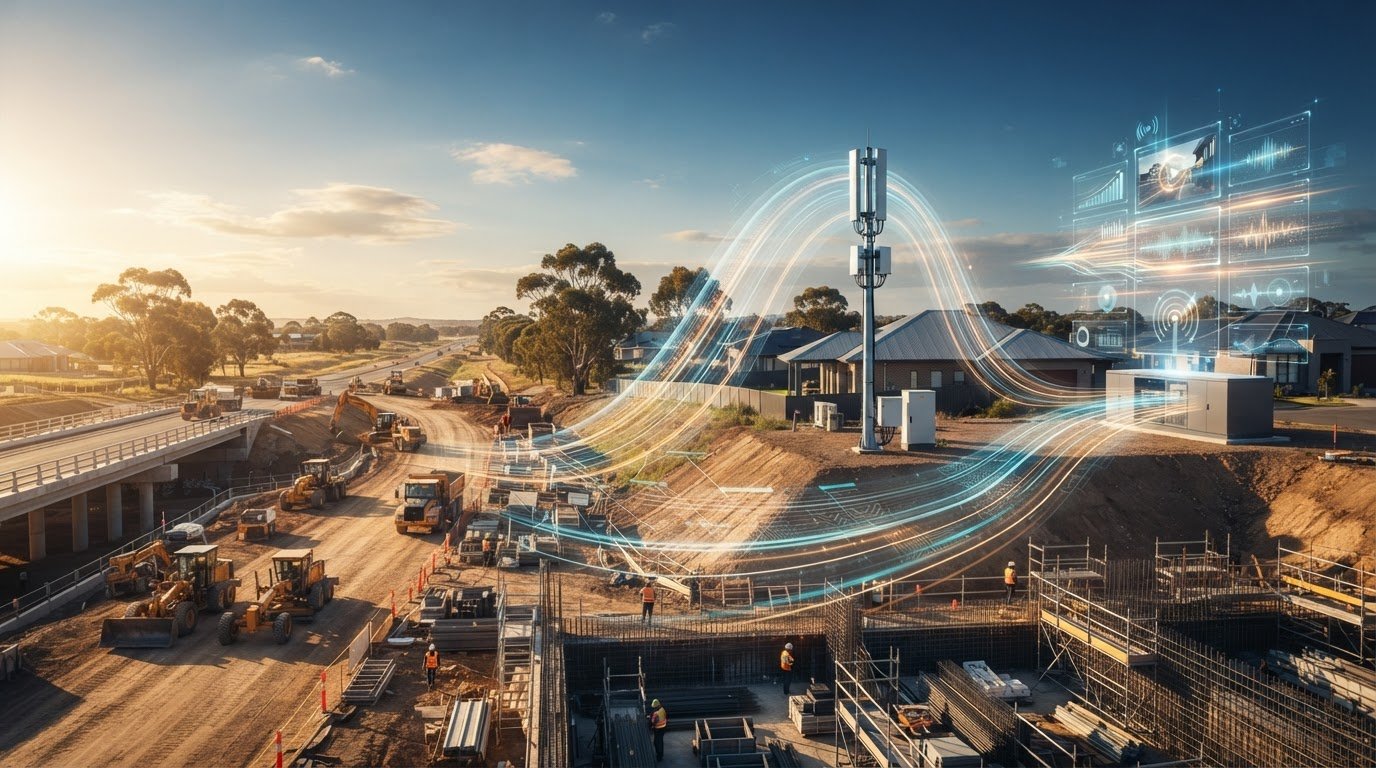
Reliable secure video surveillance demands a tech stack that operates independently of local infrastructure. Construction sites are volatile environments where mains power and fixed-line internet are often unavailable for the first 12 months of a project. To maintain 24/7 visibility, the hardware must be self-sustaining and the data must be bulletproof. This isn't about simple recording; it's about a high-performance ecosystem that keeps your site visible from any location in Australia.
Harnessing the Australian Sun
Australian construction sites benefit from some of the highest solar exposure rates globally, averaging 2,500 hours of sunshine annually. Our units leverage high-efficiency monocrystalline solar panels paired with industrial-grade lithium iron phosphate (LiFePO4) batteries. This combination provides five days of power redundancy, ensuring the system stays online during extended periods of low light or heavy rain. For project managers, this creates a set and forget environment. You don't need to worry about generator fuel or battery swaps. The hardware manages its own power consumption by throttling non-essential pings during low-voltage cycles, prioritizing continuous recording and data transmission above all else.
Data Integrity with AWS and 4GX
Data is only useful if it's accessible and protected. We utilize the Telstra 4GX network to provide high-speed data transmission across 99.2% of the Australian population. This isn't a standard public connection. It's a secure, private tunnel that moves video data directly from the edge device to the cloud. Cybersecurity is a non-negotiable priority, and industry experts emphasize preventing camera hacking through robust encryption and off-site storage protocols.
By using Amazon Web Services (AWS) for cloud storage, we implement 256-bit AES encryption for all data at rest and in transit. This cloud-first architecture provides three critical advantages:
- Scalability: Store years of high-definition time-lapse footage without worrying about local disk space.
- Speed: Instant access to live feeds and historical data with minimal latency.
- Theft Mitigation: If a unit is vandalized or stolen, your data remains safe. The footage is already off-site before the hardware is even touched.
Remote Health Monitoring
A surveillance system that fails silently is a liability. Our tech stack includes automated remote health monitoring that pings each unit every 60 seconds. This heartbeat check monitors battery voltage, internal temperature, and signal strength. If a unit experiences a drop in performance, our team is alerted before it impacts your site security. This proactive approach reduces the need for manual site visits by 85%, saving significant time and travel costs for interstate developers. You can view your project progress and system status through a single dashboard, providing total transparency without leaving the office.
This integrated approach turns the solution into a proactive management tool. It's not just about catching intruders; it's about maintaining a constant, high-definition record of your project's lifecycle. When the hardware is autonomous and the data is encrypted in the cloud, you gain the freedom to focus on delivery rather than logistics.
Asset Protection vs. Ownership: Why Hire is the Secure Choice
Owning security hardware often feels like a solid investment until the first repair bill arrives. For Australian project managers, the choice between Capital Expenditure (CapEx) and Operational Expenditure (OpEx) defines the project's bottom line. Purchasing a single 4K solar surveillance unit can cost between A$12,000 and A$18,000 upfront. This doesn't include the ongoing costs of high-speed 4G or 5G data plans, which typically add A$100 to A$200 per month. When you hire secure video surveillance, these costs vanish into a single, predictable monthly fee. You gain immediate access to premium technology without draining your project's initial cash flow.
The managed service model shifts the burden of performance from your team to the provider. This includes professional installation, 24/7 technical monitoring, and decommissioning once the job wraps up. Relying on a hire agreement ensures that the equipment on your site isn't just a box on a pole; it's a guaranteed result. You aren't just paying for a camera; you're paying for the certainty that every frame is captured and stored safely in the cloud.
The Cost of Maintaining Your Own Fleet
Hardware ownership is a race against obsolescence. By the time a three-year build concludes, purchased cameras are often two generations behind. In 2025, tech standards move fast. Hiring ensures you always utilize 2025-spec AI analytics and ultra-low-light sensors. Consider the logistics: who fixes the camera when it goes offline at 2 AM on a rainy Tuesday? If you own it, that's your problem. If you hire, the provider manages the uptime. This eliminates the nightmare of transporting heavy, fixed hardware between different regional sites, a process that often leads to calibration errors and physical damage.
Scalability for Multi-Stage Developments
Construction sites are fluid environments that change daily. A 5,000 sqm site in the excavation phase has different blind spots than the same site during the final fit-out. Hiring allows you to scale the security system footprint as the project evolves. You can start with a single tower for perimeter checks and add compact units for internal high-risk zones as expensive materials arrive on site. This flexibility prevents "security gaps" that occur when fixed hardware can't be easily moved.
- Relocation Agility: Move units as site boundaries shift to maintain 100% coverage.
- Phase-Specific Security: Increase unit counts during high-theft stages like copper installation or appliance fit-outs.
- Budget Precision: Monthly hire costs of approximately A$800 to A$1,500 per unit allow for exact forecasting.
- No Storage Costs: Avoid paying to warehouse bulky equipment between projects.
Project managers in cities like Sydney and Melbourne face unique logistical hurdles. Space is tight and timelines are aggressive. A managed hire service removes the technical distractions, allowing your team to focus on the build. You get the visual evidence needed for compliance and dispute resolution without the headache of managing a fleet of aging electronics. It's a pragmatic approach that prioritizes site visibility over equipment ownership.
Checklist: Essential Features of a Tamper-Proof System
Investing in the solution for a remote site requires more than just buying a camera and mounting it to a pole. In 2025, the difference between a grainy, useless clip and actionable evidence comes down to specific technical standards. You need a system that acts as both a silent witness and an active deterrent. A reliable setup ensures that every person entering your site is documented with enough clarity to hold up in an Australian court of law.
Visual Clarity and Night Vision
Low-resolution footage is a liability. You should treat 1080p as the absolute minimum, though 4K (8-megapixel) sensors are now the industry standard for high-stakes projects. These high-density sensors allow you to zoom in on a license plate or a face from 20 metres away without the image breaking into pixels. When choosing night vision, consider your environment. Infrared (IR) provides discreet monitoring in total darkness by illuminating the area with light invisible to the human eye. If you want to scare off intruders before they touch your equipment, white light LEDs are superior. They provide full-colour night footage and signal to the intruder that they're being watched. Pair these with a 110-degree wide-angle lens to eliminate blind spots across large equipment laydown areas.
- AI-Driven Motion Alerts: Legacy systems trigger an alert every time a gum tree sways or a stray cat wanders past. Modern intelligent software filters these out. You only receive a notification when the system detects human or vehicle shapes, reducing false positives by 95%.
- Active Deterrence: Don't just watch a theft happen. Use two-way audio to speak directly to the site or trigger a 100dB siren and strobe lights remotely. This immediate response often stops a crime in its tracks.
- Integrated Time-Lapse: Security hardware should pull double duty. High-end systems capture high-resolution stills at set intervals. This creates a professional record for stakeholder reporting and marketing, turning your security cost into a promotional asset.
Security isn't just about the hardware on the pole; it's about the reliability of the data transmission. Using encrypted 4G or 5G Australian networks ensures our cameras remain online even if local Wi-Fi fails. This constant connection is vital for maintaining a 100% uptime record on high-value civil works.
The Power of the Mobile App
A construction project is a moving target, and you can't be tethered to a desk. A professional surveillance app allows you to manage 10 or 50 different sites from a single, unified dashboard. It's about tiered access. Your site foremen might only need to see the live feed for daily coordination, while the business owner requires full access to historical archives and billing. Look for "one-click" exporting. If an incident occurs at 2:00 AM, you should be able to trim the clip and email a secure link to the police directly from your phone. This speed is critical for recovery efforts, as the first 24 hours are the most vital for locating stolen machinery or materials.
Effective site management requires total transparency and instant access to your project's progress. You can see your site from anywhere with a system designed for the rigours of the Australian construction industry.
Deploying Jobcam: Australia’s Leading Secure Surveillance Partner
Jobcam provides a comprehensive national footprint that spans Sydney, Melbourne, Brisbane, Perth, and Adelaide. We understand that Australian construction sites operate in some of the most demanding environments on earth. From the salt-heavy air of coastal developments to the extreme heat of remote mining hubs, our hardware is built to endure. We provide secure video surveillance that functions as a reliable extension of your project management team. You get more than just a camera; you gain a dedicated partner focused on site transparency and asset protection.
The Jobcam App stands as a central pillar of our service. It's a purpose-built interface designed specifically for the Australian construction industry. Unlike generic security apps, our platform prioritizes the workflows of site managers and developers. Users can toggle between high-definition live feeds and crystal-clear time-lapse archives with a single tap. This functionality allows for instant site inspections without the need for travel. On average, our clients report saving 5 hours of commute time per week by using our remote viewing capabilities to verify deliveries and site progress.
Real-world results prove the value of our technology. In October 2024, a remote renewable energy site in Western Australia utilized Jobcam’s AI-perimeter detection to thwart a high-value theft attempt. The system identified unauthorized movement at 3:15 AM and alerted our monitoring centre. This rapid response prevented the loss of approximately A$55,000 in copper cabling. Similarly, a Tier 1 infrastructure project in New South Wales used archived footage in February 2025 to successfully dispute a A$12,000 damage claim involving a third-party logistics provider. These aren't just videos; they're vital records that protect your profit margins.
The Jobcam Difference
We pride ourselves on providing local Australian support. If a site requires technical attention, our technicians offer rapid on-site maintenance to minimize downtime. Our platform is unique because it integrates professional time-lapse and security into one managed environment. You don't need separate vendors for marketing and site safety. We maintain a strict commitment to the Telstra network. By using 4GX and 5G connectivity, we ensure maximum reliability and 99.9% uptime, even when local NBN connections are unavailable or unreliable.
Getting Started
Deploying the system on your project is a straightforward process designed to respect your timeline. We follow a proven 3-step framework to get your site online quickly:
- Site Assessment: We analyze your site plans to identify optimal mounting heights and eliminate blind spots.
- Professional Install: Our qualified technicians handle the heavy lifting, ensuring all units are calibrated for maximum coverage.
- Live Monitoring: You receive immediate access to the Jobcam App, allowing you to track progress from any device.
We believe in the quality of our service, which is why we offer flexible hire units with no long-term lock-in contracts. This flexibility is essential for projects with shifting timelines or phased security requirements. You pay for what you need, when you need it, without being tied to restrictive agreements. Our pricing is transparent and scaled to the specific needs of your site, whether it's a small residential build or a massive civil engineering project.
Future-Proof Your Site Security
As we head toward 2025, the standard for site oversight has shifted from simple recording to integrated intelligence. You need more than a camera. You need a system that remains operational even in the harshest Australian conditions. By leveraging Telstra 4GX connectivity and AWS data encryption, JobCam ensures your footage is accessible and protected from the moment of capture. Choosing a hire model eliminates the initial capital outlay often required for permanent hardware. It also removes the burden of maintenance. With professional installation included and local support teams active in Sydney, Perth, Melbourne, and Brisbane, your project stays on track without technical delays.
High-definition secure video surveillance isn't just a security measure; it's a tool for real-time accountability and visual storytelling that protects your assets and your reputation simultaneously. Our 100% solar-powered units provide 24/7 reliability without requiring a single meter of cabling. This allows you to monitor progress and maintain site integrity from any device. Don't leave your project to chance when professional visibility is a phone call away. We're ready to help you see your site from anywhere and document your project's legacy.
Secure your site with Australia's leading solar surveillance hire; Get a Quote
Frequently Asked Questions
Is video surveillance data stored securely in the cloud?
Yes, all JobCam data is encrypted using AES-256 standards and stored on Australian-based servers to ensure data sovereignty. We utilize secure video surveillance protocols that protect your footage from unauthorized access at every stage. Your project data remains accessible 24/7 through an encrypted portal, providing 99.9% uptime for stakeholders. This local storage approach complies with Australian data handling standards and ensures your site remains protected from digital threats.
How do solar security cameras work at night or during cloudy weeks?
Solar cameras utilize high-capacity lithium-ion batteries that provide up to 5 days of continuous operation without direct sunlight. During daylight hours, the monocrystalline solar panels recharge the system even in overcast conditions. If battery levels drop below 20%, the system sends an automated alert to the project manager. This ensures your site monitoring equipment remains active throughout the night and during extended periods of heavy rain or cloud cover.
Can I monitor multiple construction sites from one app?
Yes, the JobCam dashboard allows you to manage up to 50 individual sites from a single login. You can toggle between live feeds in Sydney, Melbourne, or remote WA locations instantly. This centralized view increases accountability across your entire portfolio. Each site is listed by project name, allowing 1-click access to high-definition footage and real-time status updates without switching accounts or devices.
What happens if a surveillance tower is vandalised or stolen?
Every JobCam tower is equipped with GPS tracking and instant tamper alerts that notify our monitoring center the moment unauthorized movement is detected. The 4mm steel casing protects internal components from physical impact. If a unit is damaged, we provide a replacement within 24 business hours to ensure zero gaps in your site security. Our data shows that many attempted thefts result in immediate recovery due to these integrated tracking systems.
Do I need to provide a SIM card or data plan for the cameras?
No, every JobCam unit comes pre-configured with a high-speed 4G or 5G industrial SIM card and an unlimited data plan. We manage the connectivity and carrier relationships so you don't have to worry about data caps or signal dropouts. The monthly rental price includes all data costs, ensuring a fixed cost for your project budget. This plug-and-play approach allows for deployment in under 30 minutes without local network infrastructure.
Is it better to hire or buy security cameras for a 6-month project?
Hiring is the most cost-effective option for a 6-month project because it eliminates the upfront capital expenditure per unit. Rental agreements include full maintenance, technical support, and the latest hardware upgrades at no extra cost. When the project finishes, we simply collect the equipment, saving you the hassle of storage and depreciation. For projects under 18 months, hiring commonly delivers a better return on investment compared to purchasing.
Are Jobcam systems compliant with Australian privacy laws for workplaces?
Yes, JobCam systems are designed to comply with the Privacy Act 1988 and relevant state-based surveillance legislation. We provide the mandatory A3-sized high-visibility signage required for legal compliance on Australian work sites. Our software allows you to set privacy masks over sensitive areas, such as neighboring residential windows or public footpaths. This ensures your monitoring stays focused on the project site while respecting legal boundaries and worker privacy.
Can the footage be used for time-lapse marketing videos?
Yes, our high-definition cameras capture 4K images specifically for professional time-lapse production and marketing. We don't just monitor security; we document your project's legacy. At the end of construction, our editors compile the footage into a 2-minute cinematic video for your portfolio. These assets are proven to significantly increase social media engagement for developers and builders looking to showcase their capabilities to future clients.