Security Camera Systems: The 2026 Guide to Managed Site Surveillance
A construction site without eyes is a liability that costs Australian developers over A$600 million in equipment theft and vandalism every year. You've likely felt the frustration of arriving at a new development only to find fences cut and materials missing because the location lacked the mains power or fixed internet needed for traditional security camera systems. It's a common bottleneck that forces project managers to choose between expensive manual guarding or leaving their assets exposed to risk.
We agree that managing multiple sites shouldn't mean constant travel or sleepless nights worrying about site integrity. This guide reveals how modern, solar-powered technology provides total site visibility and high-definition asset protection without any physical infrastructure. You'll discover how to achieve 24/7 remote visibility and secure, evidence-grade footage that stays safe off-site. We'll break down the transition to zero-maintenance hardware that lets you monitor your progress and protect your bottom line from any device.
Key Takeaways
- Discover how modern security camera systems have transitioned from basic CCTV to cloud-integrated tools that provide total site visibility through real-time data.
- Learn why solar-powered hardware and 4GX connectivity are essential for maintaining 24/7 surveillance on remote sites without reliance on mains power or fixed internet.
- Evaluate the financial impact of managed hire versus hardware ownership, focusing on OPEX benefits and avoiding the long-term costs of technical obsolescence.
- Use our selection framework to determine the ideal camera density and unit type, whether your project requires fixed solar units or mobile surveillance towers.
- Gain peace of mind with the Jobcam App, enabling you to monitor progress and secure assets across Sydney, Perth, and Brisbane from any location.
What Defines a Modern Security Camera System in 2026?
The definition of site protection has fundamentally shifted. By 2026, the industry has moved away from passive recording toward proactive, intelligent oversight. Modern security camera systems are no longer isolated pieces of hardware. They function as integrated ecosystems combining high-end optics, 4GX or 5G connectivity, and managed cloud storage. For Australian developers managing vacant land, the old method of checking footage after an incident occurs is obsolete. You need to see your site from anywhere, at any time, with total certainty.
A true system in the current market must be autonomous. On remote Australian sites or new subdivisions, waiting for a power grid connection can delay a project by 12 weeks or more. This has led to the dominance of solar-powered units. These systems harvest energy during the day to power high-capacity lithium batteries, ensuring 24/7 operation even during consecutive overcast days in a Melbourne winter. Technology has reached a point where 99.9% uptime is the baseline expectation for commercial-grade equipment.
The distinction between residential DIY kits and commercial managed solutions is now a chasm. While a retail camera might suit a suburban driveway, it fails the rigours of a professional job site. Commercial systems offer industrial-grade housing, tamper alerts, and professional monitoring. They provide the grit required for Australian conditions, from the dust of the Pilbara to the humidity of Far North Queensland. This is about more than just a lens; it's about a robust infrastructure that survives the environment while delivering actionable data.
The End of Traditional CCTV
Hardwired infrastructure is a liability for temporary or vacant sites. Digging trenches for cables costs thousands in labour and creates permanent fixtures on land meant for flexible development. Historically, Closed-circuit television (CCTV) relied on local recording hubs that were vulnerable to theft or fire. If a thief takes the recorder, your evidence is gone. A managed security system is a combination of hardware hire and cloud-based oversight. This shift ensures that every frame captured is instantly off-site and encrypted, making the physical camera a gateway rather than a single point of failure. Real-time accessibility allows project managers to track progress or verify deliveries without leaving the office.
Why Reliability Trumps Resolution
Marketing teams often obsess over 4K resolution, but high pixel counts are useless if the data cannot reach the user. A 4K stream requires significant bandwidth. Without a stable 4GX or 5G connection, high-resolution cameras often lag or drop frames during critical moments. Reliability is the true currency of site security. In 2026, the focus has shifted to "intelligent streaming" where the system prioritises connection stability over raw resolution during peak network traffic. This ensures you never lose visibility when it matters most.
Data sovereignty is a non-negotiable requirement for Australian commercial projects. Using these units that route data through overseas servers introduces latency and potential legal complications regarding privacy and evidence handling. Local servers based in Sydney or Melbourne ensure lightning-fast access and compliance with Australian data laws. This infrastructure creates a digital paper trail that is admissible in court and accepted by insurers. It provides a level of accountability that simple recording devices cannot match. Every login, every movement, and every alert is logged, giving stakeholders a transparent record of everything that happens on their land.
The Anatomy of a Remote Site Security System
Securing remote land requires a shift from consumer-grade hardware to industrial-grade ecosystems. These security camera systems function as autonomous units, combining power generation, data transmission, and physical hardening. They're designed to operate in environments where the grid doesn't reach and traditional security fails. Every component must work in unison to ensure that "out of sight" never means "out of mind."
Powering the Surveillance: Solar & Battery Tech
Reliability starts with the sun. Modern systems utilize high-efficiency monocrystalline panels designed to capture maximum energy even during low-light conditions. These panels feed into high-capacity Lithium Iron Phosphate (LiFePO4) batteries. These units provide up to 120 hours of autonomous runtime, ensuring the site stays visible through five days of heavy cloud cover or rain. This engineering eliminates the logistical nightmare of installing temporary power poles or the A$500 weekly expense of refueling and maintaining diesel generators. It's a "set and forget" solution that respects both the project budget and the environment.
Data Integrity: From Lens to Cloud
Raw footage is useless if it stays on the device. Professional site monitoring equipment use the Telstra 4GX network to transmit encrypted data instantly. This connection provides 99.2% coverage across the Australian population, reaching fringe sites where standard Wi-Fi or 5G signals are non-existent. By leveraging AWS (Amazon Web Services) architecture, footage is stored in the cloud rather than on a vulnerable local SD card. This ensures the data is redundant and accessible from any device.
This cloud-first approach creates what we call 'Ghost Footage.' If a trespasser steals or destroys the hardware, every second of recorded activity up to the point of impact is already secured off-site. To ensure these systems meet global benchmarks for data handling, hardware should align with NIST security and privacy controls, providing a verified framework for robust information protection. Managers can choose between high-definition live-streaming for immediate incident response or scheduled 4K captures to balance data use with high-resolution visibility.
The physical build is the final layer of defense. Technology is housed in 3mm powder-coated steel enclosures with IP66 weather ratings. These casings protect sensitive electronics from 45°C heat cycles and fine dust ingress, which are common in Australian development zones. It's about building a system that survives the harsh environment as well as the intruders. You can monitor your site from anywhere with a setup designed for these exact conditions. This combination of solar autonomy, 4GX connectivity, and industrial-grade housing creates a perimeter that doesn't blink, even when the power is out and the gates are locked.
Hire vs. Buy: Why Commercial Projects Choose Managed Systems
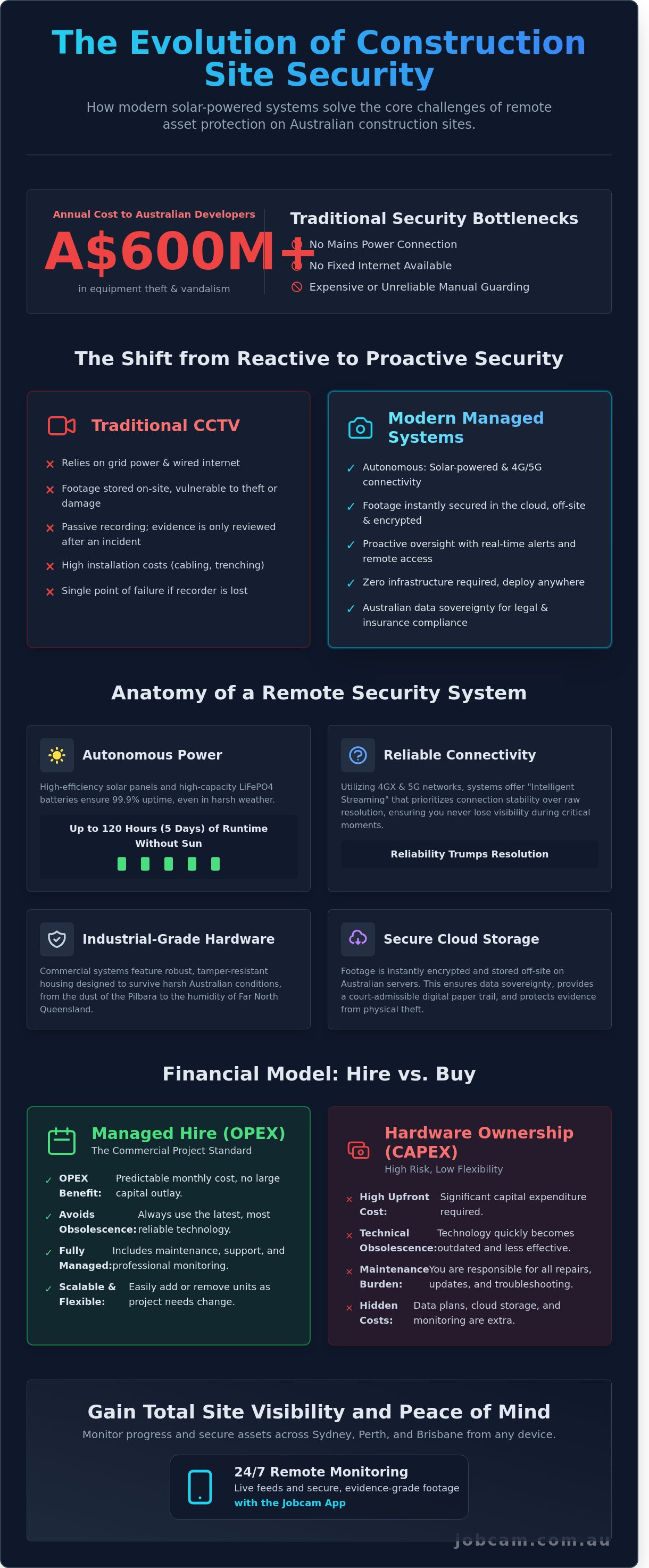
Asset management on a vacant site often comes down to a choice between Capital Expenditure (CAPEX) and Operational Expenditure (OPEX). While buying hardware seems like a permanent solution, many Australian commercial developers now prefer managed hire models. This shift is driven by the need for liquid cash flow and the elimination of depreciating assets on the balance sheet. Buying a fleet of security camera systems outright involves a significant upfront investment, often ranging from A$3,000 to A$10,000 per unit for high-spec solar hardware. This capital is then locked away in equipment that begins losing value the moment it hits the dust of a job site.
Choosing a managed system transforms security into a predictable monthly line item. It's a scalable solution that grows with the project. When you hire, you pay for the service of visibility, not just the plastic and glass of the lens. This approach ensures that your project budget remains focused on construction milestones rather than equipment maintenance. It's a practical decision for any site manager who values efficiency over ownership.
The Real Cost of Ownership
Owning hardware comes with a tail of hidden expenses that many firms overlook. Technology moves fast. A camera purchased in 2022 likely lacks the advanced AI human-detection and thermal sensing capabilities standard in 2024 models. This 24-month cycle makes 2-year-old cameras a liability rather than an asset. Beyond obsolescence, maintenance is a constant drain. In the harsh Australian climate, salt spray, red dust, and extreme heat cause hardware fatigue. If a system goes offline on a Saturday night, an owner-operator must find a technician and pay emergency call-out fees, which often exceed A$250 per hour.
- Depreciation: High-end tech loses roughly 30% of its resale value annually.
- Storage logistics: Storing bulky solar trailers between projects costs money and risks damage.
- Configuration: Every new site requires re-configuring networks and SIM cards, a task that consumes hours of expensive project management time.
Managed Hire: The Stress-Free Alternative
Managed hire removes the technical burden from your team. When you partner with a specialist, the site monitoring equipment arrive fully configured for your specific site coordinates. This service includes professional installation, high-speed data via Tier-1 Australian telco networks, and secure cloud storage for all footage. You don't need to worry about firmware updates or signal interference; the provider monitors the heartbeat of the system 24/7 to ensure 99.9% uptime. If a component fails, it's replaced at no extra cost to the project.
Insurance and liability are also simplified. Under a hire agreement, the provider typically handles the risk of hardware theft or accidental damage. This protection provides peace of mind that an outright purchase cannot offer. For a detailed breakdown of how these costs compare over a 12-month project, see our Solar Security Camera Hire Guide. This resource helps you calculate the exact ROI based on current Australian market rates. Ultimately, hiring allows you to see your site from anywhere without the headache of fixing the tech that makes it possible.
Evaluating Your Site Requirements: A Selection Framework
Selecting the right security camera systems for vacant land is a technical decision that impacts your bottom line. You don't need a dozen cameras if two high-performance units cover the entire perimeter. Effective deployment starts with understanding the difference between fixed solar units and mobile surveillance towers. Fixed units excel at monitoring specific access points or long fence lines. They provide a stable, consistent view of high-risk zones. Surveillance towers offer a 6-metre vertical advantage, providing 360-degree visibility across large, open acreages where ground-level obstructions might block a standard lens.
Many construction site thefts occur at night. This makes the choice between thermal and high-definition optics critical. Thermal imaging detects heat signatures up to 300 metres away, even in total darkness or heavy rain. It's the gold standard for early intrusion detection. Standard 4K high-definition optics are superior for evidentiary purposes, such as identifying license plates or facial features within a 25-metre radius. Combining both technologies ensures you catch the intruder before they reach your assets and have the footage to prosecute them later.
Choosing the Right Hardware Configuration
Your hardware must serve a dual purpose. While security is the priority, integrating high-resolution time-lapse capabilities adds massive value to project marketing. A 4K solar-powered unit captures the entire lifecycle of a build, providing stakeholders with weekly progress reports. This transparency builds trust and creates a visual archive for future tenders. We recommend a 100% solar-powered setup to eliminate the need for trenching or external power, which can save up to A$5,000 in initial site preparation costs on remote Australian lots.
Site Layout and Signal Strength
A site survey is non-negotiable before installation. In "concrete canyons" or dense urban developments, signal bounce can degrade video quality. We utilise 4GX technology to maintain a stable uplink where standard 4G fails. Managing blind spots requires strategic placement; a single unit mounted too low creates shadows behind site sheds or machinery. For multi-storey developments, cameras should be repositioned as the structure rises to maintain a clear line of sight. This proactive adjustment prevents security gaps that opportunistic thieves often exploit during the lock-up stage.
Compliance with Australian law is your final hurdle. The Privacy Act 1988 and various state-based Surveillance Devices Acts require clear, legible CCTV signage at all entry points. In New South Wales and Victoria, failure to display proper signage can make your footage inadmissible in court. Beyond legalities, visible signage acts as a psychological barrier. Clearly marked surveillance commonly reduces trespassing incidents compared to unmarked sites. Ensure your data is stored on Australian-based cloud servers to meet local data sovereignty requirements and reduce latency when you need to see your site from anywhere.
Jobcam: Your Partner for Australia-Wide Site Security
Jobcam delivers high-performance oversight for vacant land and active construction sites across the Australian continent. We maintain a permanent presence in Sydney, Melbourne, Perth, Brisbane, and Adelaide. This national footprint allows us to support developers who manage diverse portfolios across state lines. Vacant land represents a significant capital investment. Leaving it unmonitored for even a weekend creates unnecessary risk. We eliminate this gap with a 48-hour professional installation guarantee. Our technicians arrive, configure, and activate your system within two business days of your order. Reliability is our baseline. We've provided continuous monitoring for Tier 1 infrastructure projects with budgets exceeding A$200 million. These projects demand zero downtime and absolute accountability. Our hardware is built to withstand the 45-degree heat of a Perth summer and the intense humidity of a Brisbane storm season.
The Jobcam Ecosystem
Our proprietary app changes how project managers interact with their job sites. It simplifies multi-site management by hosting every feed in one secure interface. You don't need to be on-site to maintain control. The app provides high-definition, real-time visibility from any location. Our cameras use intelligent motion detection to filter out environmental noise. You only get notified when it matters. If a person or vehicle enters the site at 2:00 AM, an alert hits your phone instantly. For a deeper look at these features, see our guide on Using The Jobcam Mobile App for a complete feature walkthrough. This transparency reduces the need for physical site visits. Many project managers find they save significant travel time by using our remote viewing capabilities.
- Centralised Control: View all national assets from a single dashboard.
- Instant Response: Push notifications for motion events ensure no incident goes unseen.
- Evidence Grade: High-definition footage provides clear records for insurance or police reports.
Documenting Your Project's Legacy
Security is the primary goal, but the data we capture serves a dual purpose. We use high-end videography to turn a dusty site into a compelling corporate narrative. Professional time-lapse photography provides a high-impact visual record for project close-outs and stakeholder reporting. This isn't just a security log; it's a marketing asset. You can showcase three years of engineering progress in a 60-second high-definition clip. It proves your team's capability to future clients and investors. Our cameras capture every milestone with precision, ensuring no part of the build is lost to history. Accountability meets artistry. We deliver many completed time-lapse films to Australian developers annually. These assets are used in boardrooms and on social media to demonstrate site progress and operational excellence.
Future-Proof Your Site Oversight for 2026
The shift toward managed security camera systems represents a fundamental change in how Australia's Tier-1 contractors handle site risk. In 2026; project success depends on visibility that doesn't quit. By opting for a managed service; you eliminate the technical burden of maintaining hardware while gaining the power of Telstra 4GX connectivity and AWS cloud security. This ensures your data stays local and your live feed remains active; even in remote regions where traditional infrastructure fails. Choosing a rental model over a capital purchase lets you scale across multiple projects without the A$45,000+ upfront cost often associated with high-end permanent hardware ownership. It's about turning surveillance into a strategic asset that protects your bottom line and documents your project's legacy in real-time. Our national team provides the installation and support needed to keep your site compliant and connected from day one. You'll gain total accountability and the professional ability to see your site from anywhere in the world. This approach gives you the peace of mind that your project remains on track and fully documented for every stakeholder.
Secure your project with Australia’s leading managed camera systems
Let's build something remarkable together while keeping every square metre of your site protected.
Frequently Asked Questions
What is the best security camera system for a construction site?
The most effective security camera systems for construction sites are solar-powered units equipped with 4G connectivity and AI-driven motion detection. These standalone systems provide 360-degree visibility in 4K resolution without requiring any on-site infrastructure. You'll get 100% autonomous operation that captures every movement, ensuring your site remains secure even before the power grid is connected.
Can security cameras work without Wi-Fi or mains power?
Modern security cameras operate perfectly without Wi-Fi or mains power by utilizing 4G cellular networks and high-capacity solar arrays. These units feature internal lithium batteries that provide 72 hours of continuous operation even during heavy cloud cover. This makes them the ideal solution for 100% off-grid vacant land and early-stage construction projects where traditional utilities aren't available.
Is it better to hire or buy security cameras for a short-term project?
Hiring is the superior choice for projects lasting less than 18 months because it eliminates high upfront capital expenditure. A professional unit can cost over A$4,500 to purchase outright, excluding ongoing data and maintenance fees. Hiring provides a 100% tax-deductible operating expense and ensures you always have the latest technology and support throughout your project's duration.
What happens to the footage if the security camera is stolen?
Your footage is secure because it's transmitted instantly to a remote cloud server via the 4G network. Even if the hardware is physically removed or destroyed, the recorded data remains accessible through your secure online portal. Most professional systems retain 30 days of high-definition history, allowing you to identify the perpetrator and provide clear evidence to the police immediately.
How much does it cost to hire a solar security camera system in Australia?
Hiring a professional solar security camera system in Australia typically costs between A$85 and A$160 per week. This flat fee usually covers the hardware, 4G data, and cloud storage for your footage. Initial delivery and setup fees often range from A$250 to A$450 depending on your site's location and the complexity of the installation requirements.
Do I need a special permit to install security cameras on a building site?
You don't need a specific building permit, but you must adhere to the Privacy Act 1988 and relevant state surveillance laws. Ensure your security camera systems don't record private areas outside your boundary, such as a neighbor's backyard or windows. Displaying clear "CCTV in Use" signage is a legal requirement on 100% of Australian commercial sites to ensure full compliance.
How many cameras do I need to secure a standard 1,000sqm site?
Two strategically placed units are usually sufficient to monitor a standard 1,000sqm rectangular site. By positioning cameras at opposite corners, you create overlapping fields of view that cover 100% of the perimeter and internal zones. This setup ensures there are zero blind spots for intruders to exploit, providing comprehensive site transparency and security for your assets.
Can I view my site cameras on my mobile phone?
You can view your site cameras on any mobile device using a secure, dedicated application for iOS or Android. Live streams load in under 3 seconds, giving you instant visibility of your project's progress from anywhere in Australia. The app sends real-time push notifications the moment AI sensors detect unauthorized movement, allowing you to respond to incidents within seconds.