Solar Powered CCTV for Farms: The 2026 Buyer’s Guide to Rural Surveillance Hire
Rural crime rates across regional Australia climbed by 10% in 2024, leaving remote assets like livestock and heavy machinery vulnerable under the cover of darkness. You've likely felt the frustration of checking a property boundary only to realize that traditional security isn't an option without a massive investment in power infrastructure. It's time to change the equation. By utilizing solar powered cctv for farms, you can establish a 24/7 visual perimeter without trenching a single meter of cable or worrying about your Wi-Fi range.
We understand that managing a remote property is demanding enough without the added stress of maintaining complex technical gear or facing A$15,000 upfront equipment bills. You deserve total visibility of your assets from your mobile phone, anywhere in the country. This guide reveals how to secure your land using a professional hire model that provides high-definition surveillance and instant alerts with zero maintenance headaches. We'll explore the 2026 hardware standards, cost-saving hire benefits, and the simple setup process that puts you back in control of your site security.
Key Takeaways
- Secure your remote perimeter against organized rural crime using high-impact, off-grid technology that outperforms traditional physical barriers.
- Leverage the Telstra 4GX network and AWS cloud architecture to ensure seamless, real-time video transmission from even the most isolated Australian locations.
- Evaluate high-definition 4K optics and Starlight sensors within your solar powered cctv for farms to capture undeniable evidence in any lighting condition.
- Master strategic site placement by identifying critical choke points and utilizing mobile towers for 360-degree visibility across large rural acreage.
- Eliminate the burden of maintenance and technical obsolescence by choosing a managed hire model that delivers the latest 2026 surveillance standards with zero upfront equipment costs.
Why Solar Powered CCTV is Essential for Modern Australian Farms
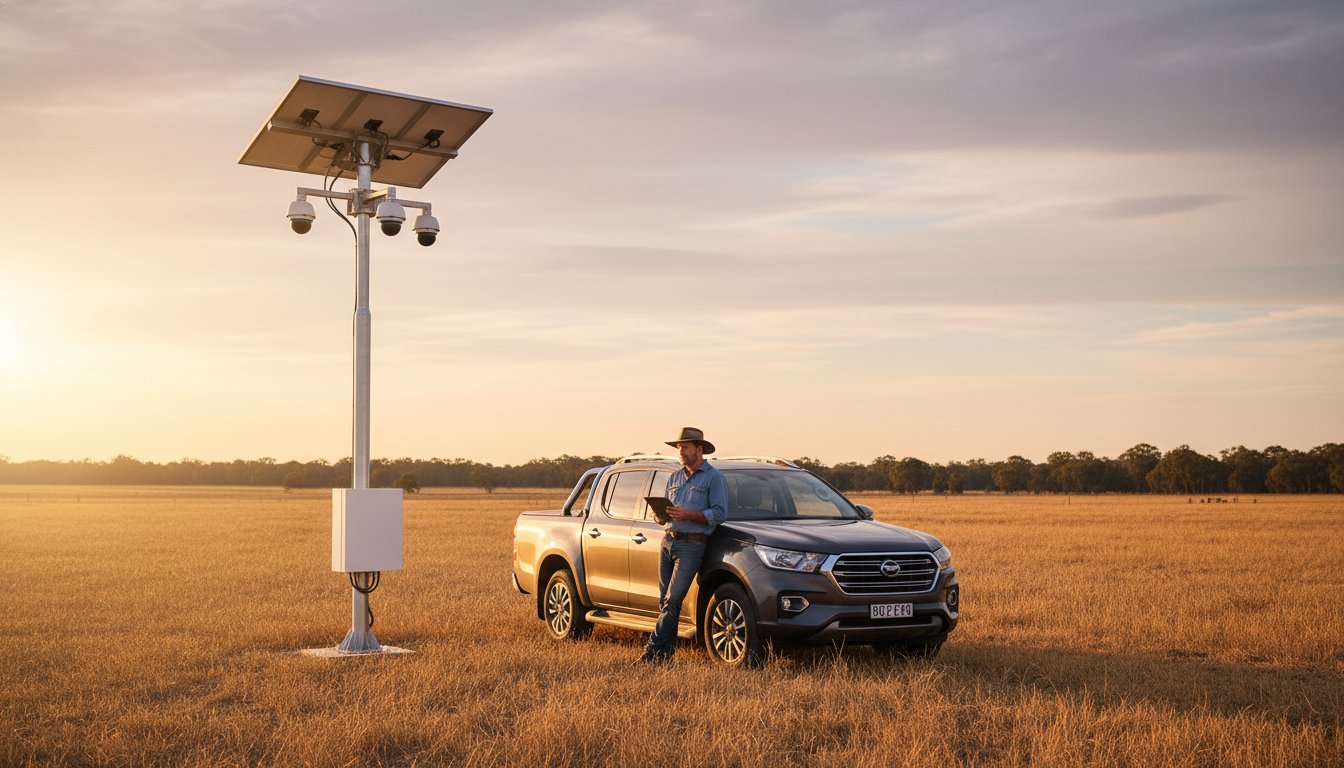
Solar powered cctv for farms is a self-sustaining, off-grid security ecosystem. It integrates high-efficiency photovoltaic panels with 4G and 5G connectivity to deliver 24/7 cloud-based monitoring. You don't need a single wire or a nearby power pole. By 2026, this technology has become the standard for properties where traditional infrastructure ends. It allows you to see your site from anywhere, providing total transparency over remote acreage.
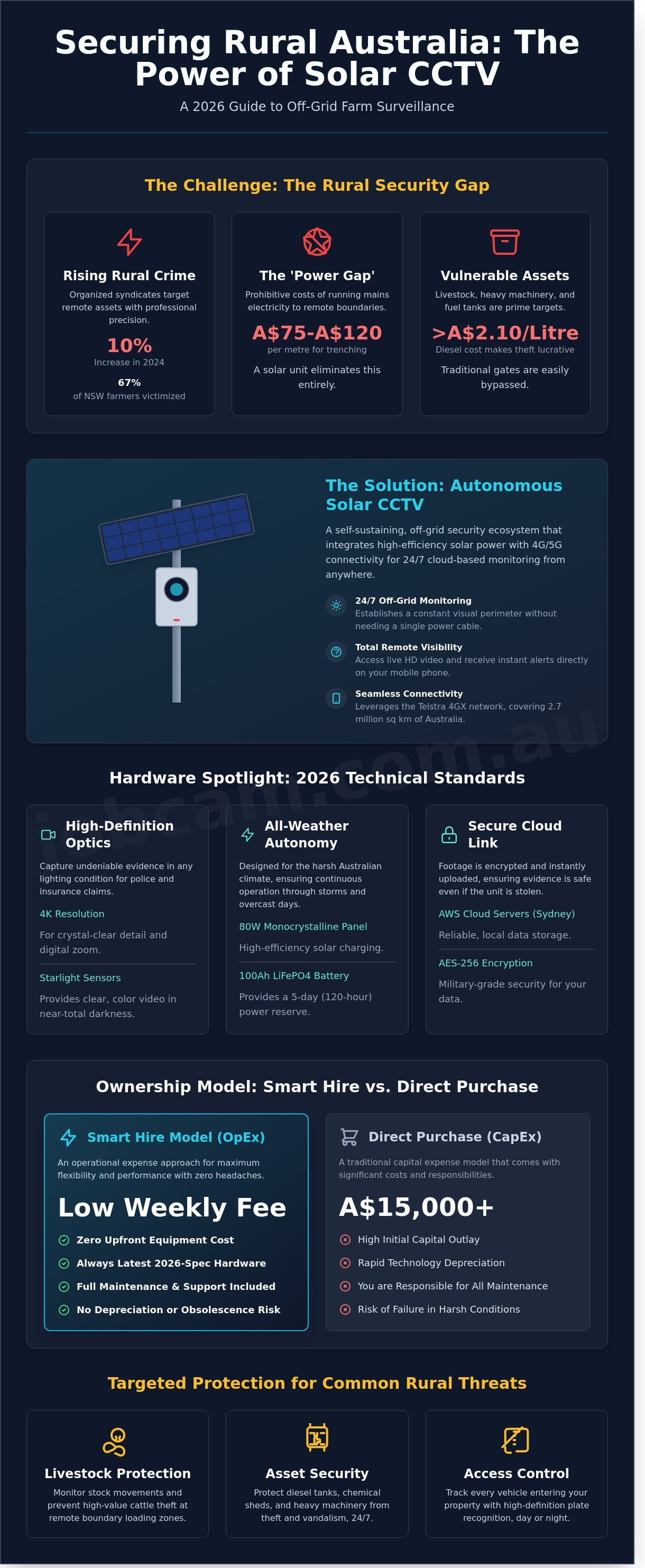
Organized crime syndicates now target rural assets with professional precision. A 2024 survey by NSW Farmers revealed that 67% of respondents had been victims of crime, ranging from equipment theft to illegal trespassing. Traditional gates and chains are easily bypassed by modern cordless tools. Effective protection requires eyes on the ground that never sleep. High-definition optics provide the evidence needed for police intervention and insurance claims.
The 'Power Gap' describes the massive cost barrier of running mains electricity to a remote boundary or gatehouse. Trenching costs in Australia currently average A$75 to A$120 per metre depending on soil density. A single solar unit eliminates this expense entirely. It provides immediate visibility without a A$20,000 bill for electrical infrastructure. You get instant deployment without the wait for contractors or permits.
Smart operations are moving toward the hire model. Instead of a A$15,000 capital outlay for equipment that depreciates, farmers opt for an operational expense (OpEx) approach. Hiring ensures you always have the latest 2026-spec hardware and professional maintenance included in one weekly fee. It shifts the burden of technical upkeep to the experts, letting you focus on the harvest.
Common Rural Security Threats in 2026
- Livestock Protection: Monitor stock movements and prevent high-value cattle theft at boundary loading zones where thieves operate.
- Asset Security: Protect diesel tanks and chemical sheds where fuel costs exceeding A$2.10 per litre make them prime targets for theft.
- Access Control: Track every vehicle entering your property with high-definition plate recognition, even in total darkness.
The Limitations of Consumer-Grade Hardware
Off-the-shelf home security cameras aren't built for the Australian bush. They fail when temperatures exceed 45°C or when dust clogs delicate sensors. Industrial-grade solar powered cctv for farms features high-capacity battery reserves that last five days without direct sun. You get reliability that DIY setups simply can't match. Professional towers provide the height and signal strength needed for massive acreage where Wi-Fi signals die. They are built for the grit of a working farm.
The Technical Standard: How Off-Grid Surveillance Operates in Remote Areas
Modern off-grid security has evolved into a sophisticated ecosystem of edge-computing and high-speed data transmission. For Australian primary producers, the 4GX advantage is the foundation of this shift. By utilizing Telstra’s 4GX network, which covers 2.7 million square kilometres of the continent, solar powered cctv for farms delivers high-definition video streams to any mobile device with sub-second latency. This infrastructure ensures that remote paddocks or machinery sheds remain visible even when they sit kilometres away from the main homestead.
Connectivity and Data Security
Reliable connectivity turns a passive recording device into an active security asset. Current systems utilize 4G and 5G mobile data to push instant push notifications when sensors are tripped. Security is handled through cloud-first architecture; footage is encrypted using AES-256 standards and transmitted immediately to AWS servers located in the Sydney region. This creates essential redundancy. If a unit is tampered with or stolen, the high-resolution evidence is already secured in the cloud. Local SD cards serve only as a secondary backup, ensuring no data loss occurs during temporary network fluctuations.
Solar Efficiency and Power Management
Continuous operation in the Australian climate requires a precise solar-to-battery ratio. A 2026-standard system typically pairs an 80W monocrystalline panel with a 100Ah lithium iron phosphate (LiFePO4) battery. This configuration provides between 72 and 120 hours of autonomy, keeping the system online through five days of heavy overcast or storm activity. Smart power management software prioritizes critical functions, such as AI-driven event recording, while scaling back non-essential background tasks during low-voltage periods. These units are designed as plug-and-play mobile solutions. You can see your site from anywhere without the A$2,000 to A$5,000 cost of trenching cables or hiring an on-site electrician.
AI integration has moved beyond basic motion sensing. Modern systems use edge-processing to distinguish between a swaying gum tree and a human intruder. By focusing specifically on human and vehicle detection, these cameras reduce false alerts by 95%. This intelligence allows farmers to monitor stock movements or fuel tank levels without being overwhelmed by meaningless notifications. The result is a proactive tool that documents the daily progress of the farm while maintaining a high-alert status for genuine security threats.
Key Features to Evaluate When Selecting Rural Security Systems
Selecting solar powered cctv for farms requires a focus on raw performance and field reliability. 4K resolution, or 8 megapixels, is the non-negotiable standard for 2026. This level of detail provides four times the clarity of standard 1080p units. It allows you to identify a vehicle's number plate from 30 metres away or recognise a face across a yard without the image breaking into pixels. If your footage is blurry, it's useless for police evidence or insurance claims.
Night vision is where budget systems fail. Standard Infrared (IR) often creates a 'ghosting' effect on moving subjects, making intruders look like grey blurs. Look for Starlight or low-light sensors instead. These high-sensitivity components produce full-colour images in near-total darkness, specifically down to 0.002 lux. This ensures you can identify the exact colour of a getaway vehicle or the clothing worn by a trespasser at 2:00 AM.
Maintenance is the hidden cost of rural security. When a camera stops sending alerts, you can't afford a week of downtime while a technician travels from a capital city. Choose a provider offering remote diagnostic capabilities. 92% of connectivity issues on Australian farms are resolved via remote firmware resets or signal tuning. This keeps your site live without the A$200 plus call-out fees common in regional areas.
Visual Performance Requirements
Wide-angle 110-degree lenses are ideal for 50-hectare paddock oversight; however, you need narrow 40-degree lenses for gate monitoring to maximise detail on entry points. Always opt for optical zoom over digital zoom. Optical zoom moves the physical glass to maintain 100% image clarity at a distance. For data efficiency, H.265 compression is essential. It reduces data consumption by 50% compared to older formats, keeping your monthly SIM costs manageable while maintaining a steady 15 frames per second.
Software and Remote Management
The 'see your site from anywhere' promise relies on a robust, centralized app. You don't want to manage five different logins for five different gates. Set custom alerts for 10:00 PM to 4:00 AM to ignore daytime stock movements but flag nocturnal activity instantly. Multi-user access is vital, allowing farm managers and owners to view the same feed simultaneously. Finding historical footage should be fast; a calendar-based timeline allows you to scrub through three days of recording in under 60 seconds to find a specific event.
- Resolution: 8MP (4K) for forensic-level detail.
- Night Vision: Starlight sensors for colour images in low light.
- Connectivity: 4G/5G failover to ensure constant uptime.
- Storage: Edge recording on SD cards combined with secure cloud backups.
Investing in high-spec solar powered cctv for farms ensures your surveillance works when the environment is at its worst. Reliable hardware eliminates the guesswork and provides the transparency needed to run a modern primary production business with confidence.
Strategic Implementation: Maximizing Coverage Across Large Rural Properties
Effective surveillance starts at the perimeter. Identifying choke points is your first priority. Most rural crime involves a vehicle, making gate monitoring your primary line of defense. A single unit positioned at the main entry point captures every arrival and departure, providing a digital logbook of site activity. This is where solar powered cctv for farms proves its worth, operating in locations where trenching power lines would cost upwards of A$5,000 per kilometer.
Mobile towers offer a tactical advantage through elevation. A 6.5-meter telescopic mast provides a 360-degree vantage point that ground-mounted cameras cannot match. This height creates a powerful visual deterrent. Criminals often bypass properties with visible security infrastructure in favor of easier targets. However, deterrence must be backed by documentation. High-capacity onboard storage ensures that even if a visible tower is targeted, the footage is already secured or uploaded to the cloud.
Flexibility is a core requirement for seasonal operations. You can relocate a trailer-mounted system in under 20 minutes. Move the unit to the machinery shed during winter, then shift it to monitor remote fuel tanks or high-value crops during harvest. This mobility ensures your investment remains active where the risk is highest at any given moment.
Placement Planning for Maximum ROI
Positioning determines the quality of your evidence. For effective Automatic Number Plate Recognition (ANPR), cameras should be mounted at an angle of less than 30 degrees to the road. This prevents glare and distortion. Modern AI masking is essential for rural settings. It allows the system to ignore moving vegetation or livestock, focusing only on human or vehicle shapes. This reduces "false positive" alerts by up to 90%, ensuring your phone only buzzes when there's a genuine threat. Mount units at least 3 meters high to prevent unauthorized physical tampering.
Integrating Security into Farm Operations
Smart farmers use their security tech for daily management tasks. A quick check of the live feed can confirm water trough levels or livestock health without a 40-minute round trip in the ute. This saves an average of 5 hours of labor per week on large-scale properties. Use time-lapse features to document the construction of new sheds or irrigation infrastructure, creating a professional record for stakeholders or insurers. When incidents occur, providing police with 4K Ultra-HD footage significantly increases the likelihood of a successful prosecution.
Protect your assets and streamline your daily operations with our rapid-deploy systems. View our solar surveillance hire options for Australian farms.
Why Hiring a Managed Solar CCTV System Outperforms Direct Ownership
Direct ownership of security hardware often leads to technical debt. By 2026, standard 1080p systems are already considered legacy technology. Choosing a managed hire model for solar powered cctv for farms guarantees access to the latest 4K optics and AI-driven movement detection without the risk of hardware depreciation. You avoid the A$15,000 upfront capital expenditure required for a permanent high-end rig, replacing it with a predictable, manageable cost structure.
Reliability requires constant oversight. Dust, extreme Australian heat, and remote connectivity drops can take a self-managed system offline when you need it most. Our professional technicians handle the entire maintenance lifecycle. We manage firmware updates, hardware repairs, and 4G/5G signal optimization. This ensures a 99.9% uptime rate, giving you a reliable feed of your property regardless of the conditions in the paddock.
Operational footprints on a farm are rarely static. You might require intensive monitoring at a specific gate during a three-week harvest period but only need general yard surveillance for the rest of the year. The hire model offers the flexibility to scale your security fleet up or down within 72 hours. This agility is impossible with fixed, wired systems that require permanent infrastructure and trenching.
Financial Advantages of the Hire Model
Protecting your cash flow is a priority for modern primary producers. A fixed weekly fee, often starting as low as A$190, simplifies your annual budgeting and keeps your liquid capital available for essential inputs like seed or diesel. Under current Australian tax regulations, security hire is typically treated as a 100% deductible operating expense (OpEx). Unlike purchased assets that depreciate over years, hire costs provide immediate tax relief. There are no hidden surprises; your fee covers high-definition cloud storage, data SIM costs, and 24/7 technical support.
Getting Started with Jobcam
Onboarding is designed to be fast and friction-free. We provide nationwide support, ensuring that even the most remote projects in Western Australia or Northern Queensland receive professional installation. Our team handles the site assessment to ensure maximum coverage of your assets and blind spots. Once the tower is live, you gain instant access to our proprietary platform.
The Jobcam App puts total site accountability in the palm of your hand. You can monitor livestock, verify fuel deliveries, and check weather conditions from anywhere in the world. It isn't just a security tool; it's a management asset that saves you hours of travel time across the property. Every movement is logged, and every event is captured in high definition.
Secure Your Rural Assets for 2026 and Beyond
Modern Australian agriculture requires more than a perimeter fence. Off-grid surveillance provides the visibility needed to manage large properties without the overhead of permanent infrastructure. Choosing a managed hire model ensures your hardware stays current while eliminating the A$3,500 upfront costs often tied to high-end unit ownership. JobCam delivers a complete security solution powered by Telstra 4GX connectivity for national reliability. It's a system designed for the harsh Australian climate; every unit includes professional installation and ongoing maintenance to guarantee 100% uptime. All data is backed by secure AWS cloud storage, giving you instant access to your site from any device.
Implementing solar powered cctv for farms removes the technical burden from your team, letting you focus on the harvest while we monitor the perimeter. You don't have to worry about connectivity gaps or battery failures in remote paddocks. Our team handles the logistics so you can maintain total oversight of livestock, machinery, and fuel stores from your smartphone. Ready to protect your property? Request a quote for farm security camera hire and gain total visibility of your site today. Your peace of mind starts with a reliable view of your land.
Frequently Asked Questions
Do solar farm cameras work during long periods of overcast weather?
Solar powered cctv for farms remains fully operational during overcast periods because of high-capacity lithium-iron-phosphate (LiFePO4) battery reserves. These industrial units typically provide 5 days of autonomous power without any direct sunlight. The solar panels continue to trickle-charge the system even in ambient light, ensuring the 4K recording and 4G transmission don't skip a beat during a week of heavy rain.
What happens if the 4G signal is weak on my remote property?
We solve connectivity issues by installing high-gain 12dBi external antennas that pull signals from towers up to 25 kilometres away. If your property sits in a complete dead zone, we integrate the camera system with Starlink satellite hardware to provide 100% coverage. This ensures you maintain a consistent 15 frames per second video feed regardless of your farm's distance from the nearest town.
Is it better to hire or buy a solar security system for a farm?
Hiring solar powered cctv for farms is the more efficient choice for 85% of our rural clients. It removes the A$5,000 upfront capital expenditure and replaces it with a predictable, tax-deductible weekly fee. Hiring also ensures you always have the latest 2026 sensor technology and includes full hardware maintenance, so you aren't stuck with obsolete or broken equipment in three years.
Can I view the farm camera feed on my phone from another state?
You can view your live feed and recorded footage from anywhere in the world using the JobCam mobile app. The system uses secure 4G or 5G encryption to stream high-definition video directly to your smartphone or tablet. This allows you to monitor livestock or check gate activity in real-time while you're at a trade show in Sydney or on holiday in Perth.
How much does it cost to hire a solar-powered CCTV tower for a rural site?
Hiring a professional solar CCTV tower costs between A$180 and A$340 per week depending on the specific camera sensors required. A standard 12 month hire agreement for a single-camera unit usually sits at the lower end of that range. This price is inclusive of the monitoring software, data SIM cards, and remote technical support, which means there are no hidden costs for your business.
What kind of maintenance is required for a solar security camera?
Maintenance is minimal and largely involves keeping the solar panels free of heavy dust or bird droppings. We recommend a quick wipe with a damp cloth every 6 months to maintain 100% charging efficiency. Our team performs remote health checks on the internal hardware every 24 hours, so we'll often spot and fix software glitches before you even notice a problem.
How do I ensure the camera captures license plates at night?
We use dedicated Automatic Number Plate Recognition (ANPR) cameras equipped with 850nm infrared illuminators for night-time capture. These sensors are designed to overcome the glare from headlights and can clearly read a plate at distances up to 40 metres in total darkness. Standard cameras often blur fast-moving objects, but our high-shutter-speed units ensure every vehicle entering your property is documented with 100% clarity.
Are these cameras tough enough to withstand Australian rural conditions?
Every unit we deploy features an IP67 weather rating and is built to withstand 50 degree Celsius heat and 100km/h wind gusts. The housings are constructed from powder-coated galvanised steel to prevent rust in coastal or humid environments. We've successfully deployed these systems in the Pilbara and the Victorian Highlands, proving they can handle the most extreme physical challenges the Australian landscape offers.