Surveillance Cameras & Security: The Complete Guide to Remote Site Protection in 2025
Traditional security guards and hardwired CCTV aren't just expensive; they're becoming obsolete on the modern Australian worksite. In 2024, site theft and vandalism cost the local construction industry billions of dollars annually. Relying on a perimeter fence and a prayer doesn't work when your project lacks a stable NBN connection or reliable on-site power. You've likely felt the sting of a Monday morning discovery where A$20,000 of plant equipment has vanished overnight. It's a common pain point that stalls timelines and spikes insurance premiums. This guide explores why advanced surveillance cameras security systems are shifting toward autonomous, solar-powered units that eliminate the need for traditional infrastructure.
We agree that your focus should be on building, not policing your perimeter. You'll discover how managed hire services provide a set and forget solution that delivers 24/7 high-definition visibility directly to your smartphone. We will break down the technical shift toward AI-driven detection and how industrial solar setups ensure your site stays protected through the entire project lifecycle, regardless of location.
Key Takeaways
- Shift from reactive CCTV to a proactive AI-driven security ecosystem designed to deter threats in real-time across Australian project sites.
- Understand the mechanics of off-grid solar towers and how modern battery storage ensures 24/7 visibility even during extended overcast periods.
- Analyze the Total Cost of Ownership (TCO) to see why managed hire services for surveillance cameras security outperform purchasing for 6-24 month projects.
- Master strategic site layouts by identifying critical zones like fuel tanks and laydown areas while using height to eliminate vulnerable blind spots.
- Discover how a national support network across Sydney, Melbourne, Perth, Brisbane, and Adelaide guarantees 99.9% uptime for your remote site protection.
Surveillance Cameras & Security: Beyond the Retail Hardware
Professional security isn't a passive tool. It's an active ecosystem. In the Australian construction sector, the stakes are too high for basic hardware. Investing in high-end surveillance cameras security transforms a site from a vulnerable asset into a controlled environment. This shift moves beyond simple recording. It creates a framework of accountability that protects both physical assets and project timelines.
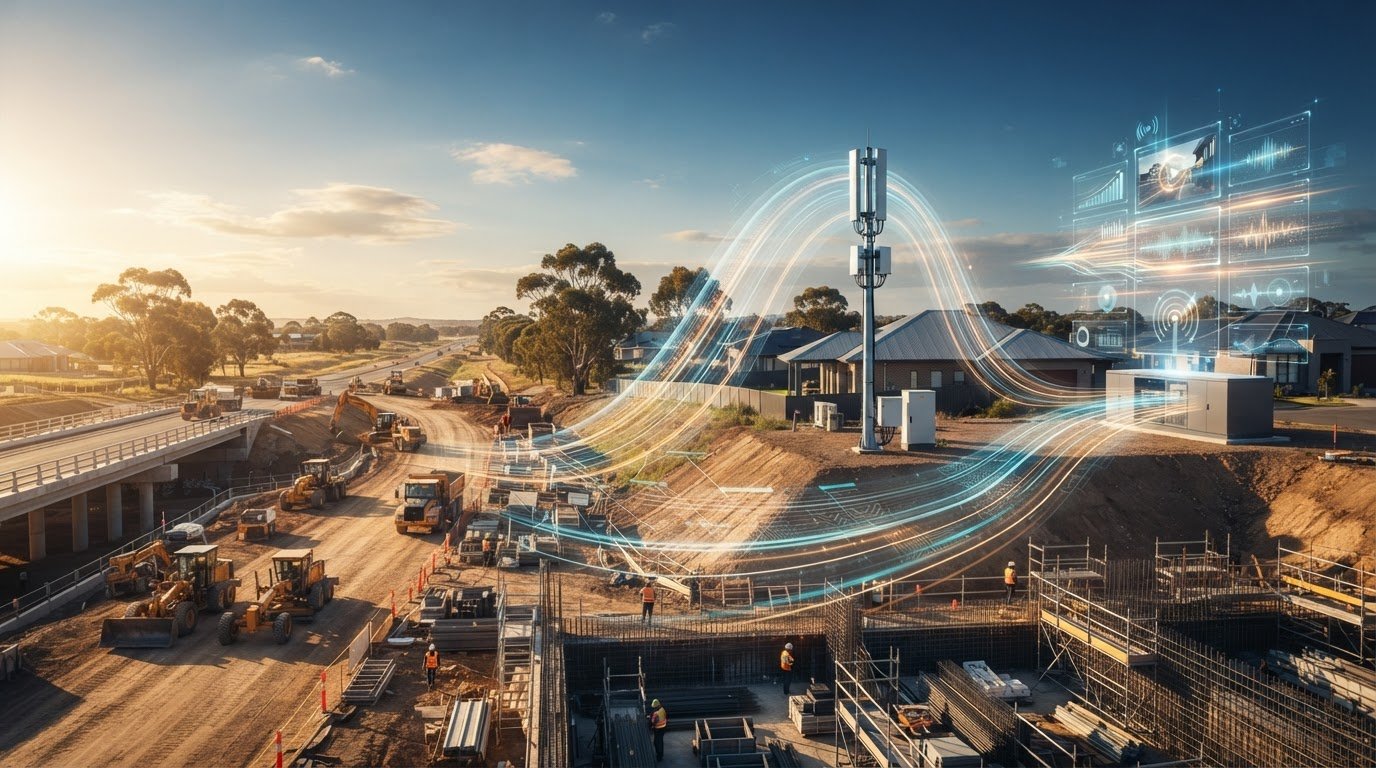
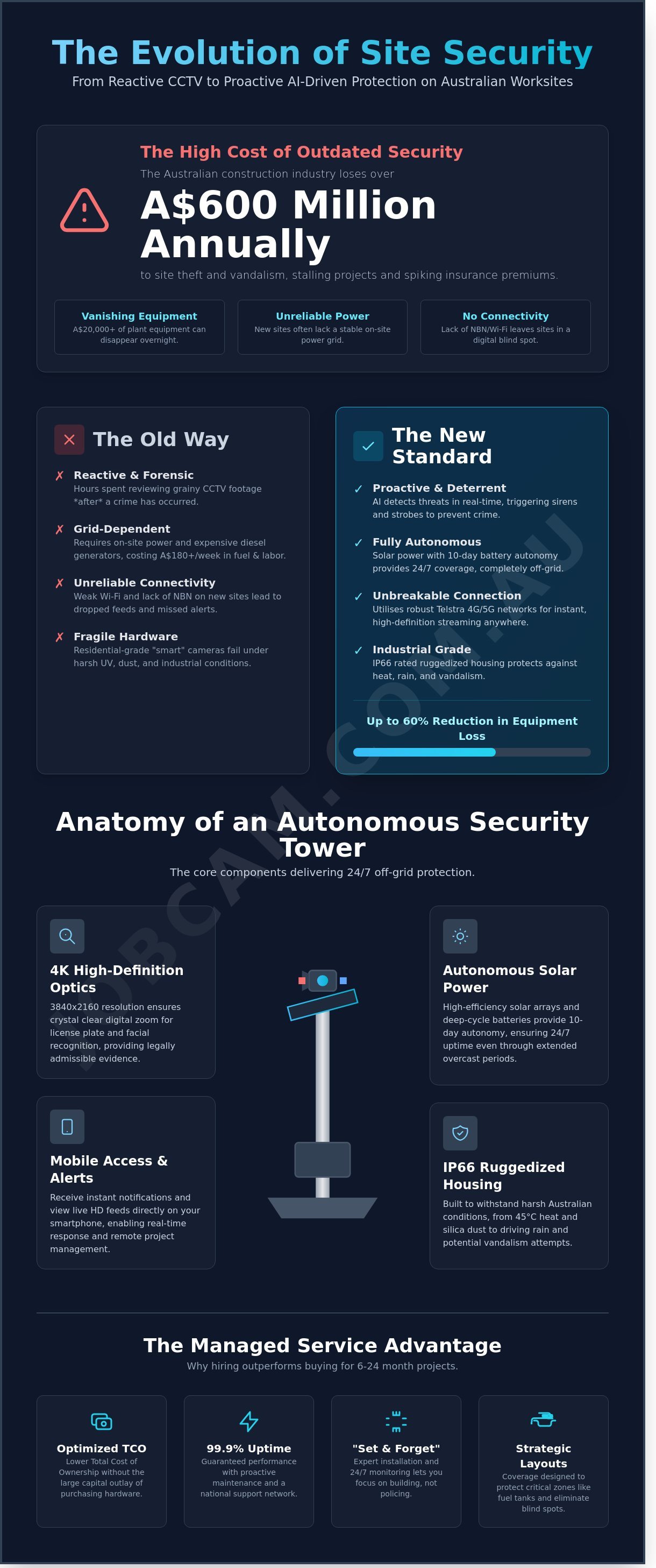
Historically, Closed-circuit television (CCTV) served as a forensic tool used only after an incident occurred. If a site was vandalised, managers spent hours reviewing grainy footage to identify a suspect. Today, the Australian market has shifted toward real-time AI-driven deterrents. These systems use edge computing to identify threats as they happen. Many sites using these systems commonly report significant reductions in equipment loss on major infrastructure projects. Modern systems don't just watch; they intervene with sirens and strobe lights before a crime is committed.
Residential "smart home" cameras often fail in industrial settings. They lack the focal range and the physical durability required for a 20,000 square metre development. Industrial-grade site monitoring equipment must handle harsh UV exposure and fine silica dust common in Western Australia or Queensland. While a home camera might trigger a notification for a stray cat, professional site towers use sophisticated algorithms to distinguish between a security breach and a shifting shadow. This precision eliminates notification fatigue for project managers.
You deserve the ability to see your site from anywhere. This central brand promise isn't just about catching intruders. It's a fundamental tool for modern project management. High-definition feeds allow stakeholders to verify material deliveries, monitor sub-contractor safety compliance, and provide visual updates to investors without leaving the office. It's the standard for transparency in a high-stakes industry.
The Core Components of Industrial Surveillance
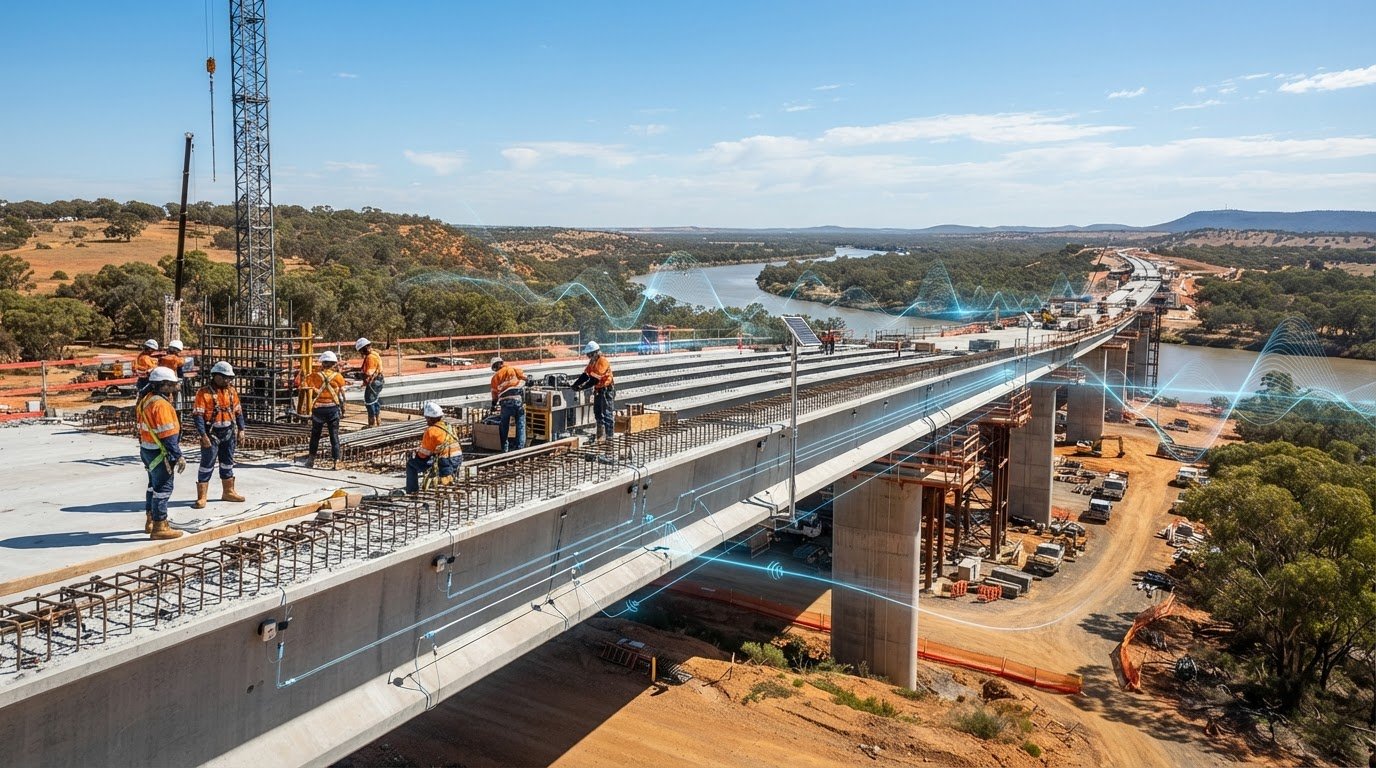
Success on a job site depends on three technical pillars. First, 4K high-definition optics are now the baseline. A resolution of 3840 x 2160 ensures that digital zooming provides clear license plate recognition and facial identification for legal evidence. Second, autonomous power is non-negotiable. High-efficiency monocrystalline solar arrays and deep-cycle battery banks ensure 24/7 uptime, even during consecutive overcast days in a Melbourne winter. Finally, ruggedised housing with an IP66 rating protects sensitive electronics from 45-degree heat, driving rain, and deliberate vandalism attempts.
Connectivity: Why Wi-Fi is the Weak Link
Relying on Wi-Fi or local fixed-line internet is a mistake for new developments. Most greenfield sites don't have NBN connectivity during the critical early phases of construction. Even when available, Wi-Fi signals degrade over long distances and struggle to penetrate concrete and steel structures. This leads to dropped feeds and missed alerts at the exact moment you need them most.
We solve this by using the Telstra 4GX and 5G networks as the primary backbone. These cellular networks provide the bandwidth necessary for streaming high-bitrate video from remote locations across Australia. Managed Connectivity acts as the essential bridge between site hardware and the delivery of real-time mobile alerts. This ensures that whether you're in the CBD or at home, your connection to the site remains unbreakable and instantaneous.
Solar-Powered Surveillance: The Off-Grid Security Standard
Security shouldn't depend on a power cord. For remote Australian construction sites, solar-powered units provide the only viable off-grid standard. These towers use high-efficiency photovoltaic panels to feed a bank of deep-cycle batteries. This creates a self-sustaining loop. The system captures energy during the day and stores it for high-intensity night vision and 4G/5G data transmission. It's a closed-loop solution that eliminates the need for expensive trenching or temporary power poles.
Cloudy days don't kill your coverage. A common myth suggests that solar units fail when the sun disappears. In reality, modern systems are engineered with a 10-day autonomy ratio. Even in overcast conditions, panels harvest ambient light to maintain a trickle charge. This ensures your site monitoring equipment remains active 24/7. Unlike diesel generators that require weekly refueling trips costing upwards of A$180 in labor and fuel, solar units are virtually maintenance-free. They don't leak, they don't make noise, and they don't emit carbon.
Mobility is the primary advantage during shifting project phases. Moving a diesel generator is a logistical headache involving spill kits and heavy lifting. Solar units sit on towable trailers. As site boundaries move from the excavation phase to the fit-out phase, you can reposition the tower in 15 minutes. This adaptability keeps the perimeter secure without needing a technician to rewire fixed points. It's a practical approach for fast-paced developments where the high-risk zones change weekly.
Harnessing the Australian Sun for 24/7 Protection
In regions like the Pilbara or Far North Queensland, heat is the enemy of electronics. Our systems use industrial-grade charge controllers to manage the 400-watt input from the panels. This prevents battery degradation and ensures a steady flow of power. A typical high-definition camera draws roughly 15 to 25 watts; with a 200Ah battery bank, the math ensures your site stays visible even through a week of heavy storms. You can monitor your project progress from any device, knowing the hardware is self-sufficient and ruggedised for the 45-degree heat of a WA summer.
- Deep-cycle lithium technology: Provides deeper discharge cycles than standard lead-acid batteries without losing capacity.
- Maintenance-free operation: No oil changes or mechanical parts to wear out in dusty environments.
- Real-time voltage monitoring: Receive alerts if the system detects a drop in battery health before it affects uptime.
Mobile Surveillance Towers vs. Fixed Pole Mounts
Height matters for deterrence. A 6-meter mast provides a 360-degree vantage point that fixed pole mounts can't match. It's a psychological barrier. Intruders see the tower from 100 meters away and choose an easier target. Smaller, compact solar units work better for internal site monitoring where space is limited. You can deploy a full perimeter of three towers in under 120 minutes. This speed is critical for civil works projects where the site footprint changes every 48 hours. Fixed poles are permanent and expensive; mobile towers are agile and responsive to your site's actual needs.
Hire vs. Buy: The Commercial Case for Managed Security
Purchasing hardware feels like building an asset. In the fast-moving world of site protection, it is often a growing liability. For projects spanning 6 to 24 months, the upfront capital expenditure for high-end surveillance cameras security systems rarely justifies the total cost of ownership. A single autonomous surveillance tower can cost upwards of A$18,000 to purchase outright. When you factor in the 22% annual depreciation rate for electronics, that asset loses significant value before the first slab is even poured.
Hiring shifts the financial burden from a heavy upfront cost to a manageable monthly operating expense. This model eliminates the "Technology Obsolescence" trap. AI-driven detection capabilities move at a breakneck pace. A unit purchased in 2024 will lack the edge-computing power and sensor resolution standard in 2025. By hiring, you ensure your site is always protected by the latest 4K optics and thermal imaging without having to sell off old, redundant gear at a loss. Managed security means you pay for the outcome, which is a secure site, rather than the hardware itself.
The Hidden Costs of Owning Surveillance Hardware
Owning hardware involves more than just the initial invoice. Maintenance is a primary profit killer. If a camera sensor fails on a site 500km from your head office, the logistics are a nightmare. You'll face technician call-out fees that often start at A$150 per hour plus travel. In a hire agreement, these risks stay with the provider. We handle the repairs, so you don't have to worry about downtime or unexpected bills.
- Data and Storage: High-definition streaming consumes massive amounts of bandwidth. Managing individual SIM cards and cloud storage subscriptions can add A$80 to A$120 per month, per unit, in administrative overhead.
- Asset Management: Between jobs, you need a secure, weatherproof warehouse to store towers. You also need staff to test, clean, and recalibrate the site monitoring equipment before it moves to the next project.
- Transport Logistics: Moving a two-tonne surveillance trailer requires specialised vehicles and hours of labour that could be better spent on-site.
Operational Flexibility of the Hire Model
Construction sites are dynamic. A project that starts as a flat lot in January becomes a complex multi-storey structure by August. The hire model allows for instant scalability. You can start with two towers and scale up to six as the site footprint expands. When the build reaches the lock-up stage and internal security becomes the priority, you simply return the towers. This flexibility prevents you from paying for equipment that is sitting idle in a yard.
The financial structure also offers distinct advantages for Australian firms. Hire fees are typically 100% tax-deductible as an operating expense (OpEx). This keeps your balance sheet clean and preserves your borrowing capacity for core machinery or materials. Beyond the tax benefits, you get continuous software updates. Every month, your system gets smarter through cloud-based AI patches. You aren't just hiring a camera; you're hiring a dedicated technical support team that monitors your uptime 24/7. This level of professional oversight is impossible to replicate with a "buy and forget" approach.
Strategic Site Layout: Maximising Your Surveillance Coverage
Placement is the difference between a secure site and a vulnerable one. Effective surveillance cameras security relies on a calculated layout that prioritises high-risk areas. On a typical Australian construction site, these "Critical Zones" include primary gateways, material laydown areas, and fuel tanks. Gateways require 24/7 monitoring to track every vehicle and individual entering the site. Laydown areas house the bulk of your inventory, while fuel tanks remain a frequent target for opportunistic theft. Statistics from the Australian Institute of Criminology indicate that site theft costs the national industry over A$650 million annually. You can't afford gaps in your visibility.
Height is your greatest tactical advantage. A surveillance tower provides a 6-metre vantage point that ground-level cameras cannot match. This elevation eliminates the blind spots created by shipping containers, stacked timber, or heavy machinery. Thieves exploit these shadows to move undetected. By positioning towers at strategic corners, you create a digital perimeter. This virtual fence uses motion-activated alerts to notify your team the moment a boundary is breached. It's a proactive system that moves beyond simple recording to active prevention.
Your layout also serves operational needs. Modern surveillance isn't just about catching intruders; it's about maintaining safety compliance and verifying progress. High-definition feeds allow project managers to monitor PPE adherence and plant movements without being physically present. This constant visibility fosters a culture of accountability across the entire workforce.
The 3-Point Coverage Strategy
- Point 1: Perimeter Monitoring. Detect unauthorised entry at the earliest possible stage. By securing the boundary, you gain the lead time necessary to alert authorities before damage occurs.
- Point 2: Asset-Specific Focus. Direct high-resolution lenses toward your most valuable equipment. Whether it's a A$300,000 excavator or a stockpile of copper piping, these assets require dedicated oversight.
- Point 3: Wide-Angle 'God's Eye' View. Use a panoramic perspective for total project management. This view captures the macro-movements of the site, providing the data needed for logistical adjustments and time-lapse documentation.
Leveraging Cloud-Based Accountability
Visibility is only useful if it's accessible. Site managers use the Jobcam mobile app to perform daily check-ins from their home or office. This real-time access removes the need for constant site visits, saving hours of travel time each week. All footage is backed up to AWS Cloud Storage. This ensures your data remains protected even if a physical camera is damaged or stolen during a breach. It provides an immutable record for insurance claims or legal disputes.
We also transform your security feed into a powerful marketing asset. Our high-definition time-lapse captures every stage of the build, from the first pour to the final fit-out. You can use this footage to showcase your project's progress to stakeholders or use it in future tenders to prove your operational efficiency. It’s a dual-purpose tool that protects your site today while helping you win your next contract tomorrow.
Ready to secure your project with professional-grade oversight? See your site from anywhere with Jobcam’s surveillance solutions.
The Jobcam Advantage: Professional Surveillance Across Australia
Jobcam operates as a direct extension of your project management team. We provide a comprehensive security blanket across Australia, maintaining a strong physical presence in Sydney, Melbourne, Perth, Brisbane, and Adelaide. Our footprint allows us to deploy enterprise-grade site monitoring equipment to any Tier 1 or Tier 2 site within 48 to 72 hours. This national reach is backed by a commitment to 99.9% uptime, ensuring your site remains visible even in the most demanding environmental conditions.
Reliability isn't a vague promise; it's a technical standard. We integrate Telstra 4GX connectivity to bypass the limitations of local Wi-Fi or congested site networks. Every byte of footage is processed through Amazon Web Services (AWS) to guarantee enterprise-grade data security and sovereignty. Your data stays protected, encrypted, and accessible only to authorised personnel. This high-tech backbone allows project managers to monitor progress and security from any device, anywhere in the world, without the lag or downtime common in consumer-grade setups.
Our approach centers on the "Reliable Expert" philosophy. We don't just drop equipment at your gate. Our local support teams understand the specific logistical hurdles of each state, from the high-humidity challenges in Brisbane to the dust mitigation required on Perth civil sites. By managing the hardware, the connectivity, and the cloud storage, we remove the technical burden from your site office. This leaves your team free to focus on construction milestones while we handle the constant vigilance required for total site accountability.
National Service, Local Expertise
Jobcam is headquartered in Balcatta, WA, serving as the central hub for our national distribution network. While our technology is global, our service is local. Choosing professional installation over a DIY setup is a critical risk-management decision. On a multi-million dollar development, a hardware store camera is a liability, not a security feature. Our technicians ensure optimal placement for maximum coverage, eliminating blind spots that DIY installations frequently miss. As your site evolves and structures rise, we provide relocation services to move your towers, ensuring your line of sight is never compromised by the building's progress.
Next Steps for Your Project Security
Securing your assets starts with a site-specific security proposal. We don't believe in one-size-fits-all packages. Our experts analyse your site blueprints and perimeter requirements to recommend the exact number of towers needed for 100% coverage. We offer flexible hire terms and contract options that align with your project timelines, whether you're breaking ground on a six-month build or managing a multi-year infrastructure project. There are no hidden fees or complex technical hurdles; we provide a streamlined, transparent path to total site visibility.
Don't leave your site's integrity to chance. Secure your site today with Jobcam's solar surveillance towers and experience the peace of mind that comes with professional, high-definition oversight. Our team is ready to deploy the hardware and expertise you need to protect your investment and showcase your project's legacy from day one.
Protect Your Perimeter with Smarter Surveillance
Remote site protection in 2025 demands more than just basic hardware; it requires a managed ecosystem that functions without local power or fixed-line internet. By choosing 100% off-grid, solar-powered units, you eliminate the logistical headaches of cabling and site-wide power outages. Our internal data shows that managed hire models offer a superior commercial case over ownership, particularly when you factor in the rapid 24-month technology refresh cycles. You don't need to own the gear to own the results.
Effective site monitoring equipment relies on robust connectivity and enterprise-grade data integrity. Jobcam units leverage the Telstra 4GX network and are AWS-powered to ensure your footage remains accessible from any device, anywhere in Australia. With national AU support and 24/7 monitoring capabilities, you're never left managing technical failures on your own. You get high-definition visibility and total accountability across every square metre of your development. It's time to secure your assets and maintain momentum on your project.
Get a Fast Quote for Site Surveillance Hire
Frequently Asked Questions
Do solar security cameras work at night or during cloudy weather?
Yes, solar security cameras operate continuously through the night and during extended overcast periods. These units feature high-capacity lithium-ion batteries that store surplus energy during daylight hours. Most JobCam surveillance towers provide up to 120 hours of autonomous power without any direct sunlight. This ensures your site remains protected 24/7, even during a full week of heavy rain in Melbourne or Sydney. You'll never lose visibility due to weather.
What is the difference between hiring and buying a construction site camera?
Hiring is the preferred choice for many construction projects because it eliminates upfront capital expenditure and maintenance responsibilities. When you hire, you receive the latest high-definition technology and 24/7 technical support included in the rate. Buying requires a larger initial investment of A$15,000 or more and places the burden of hardware repairs on your team. Hiring allows you to implement site monitoring equipment across multiple sites without managing hardware assets.
Do I need to provide a SIM card or internet for the surveillance cameras?
You don't need to provide a SIM card or an internet connection for our surveillance towers. Every unit comes equipped with industrial-grade 4G or 5G routers and pre-configured data plans. This plug-and-play approach ensures the system is active within 30 minutes of delivery. We manage the network connectivity and data costs, so you can focus on project delivery without worrying about site IT infrastructure or complex telco contracts.
How much does it cost to hire a solar surveillance tower in Australia?
Hiring a solar surveillance tower in Australia typically costs between A$150 and A$450 per week; this depends on the camera configuration and project duration. For a standard 12-month civil project, rates often sit at the lower end of this scale. These prices usually cover delivery, installation, and access to the monitoring software. Requesting a fixed-price quote helps project managers lock in budgets and avoid the hidden costs of guards.
Is the footage recorded on-site or in the cloud?
Footage is recorded both on-site and in the cloud to ensure maximum data redundancy. The hardware stores high-resolution video locally on industrial-grade SD cards or hard drives for 30 days. Simultaneously, the system uploads key events and time-lapse frames to our secure Australian-based cloud servers. This dual-layer approach means you won't lose critical evidence if the unit is damaged or if the local storage fails during a power cycle.
Can I view the live camera feed from my mobile phone or office computer?
You can view the live camera feed from any mobile phone, tablet, or office computer. Our platform provides a seamless interface accessible through a dedicated app or a standard web browser. This allows project managers to track site progress and monitor site monitoring equipment in real-time from anywhere in the world. High-definition streams ensure you see every detail, providing total visibility and accountability for your stakeholders and remote teams.
Are these cameras legal for monitoring staff on a construction site?
Monitoring staff is legal across Australia if you follow the Workplace Surveillance Act and relevant state privacy laws. You must provide employees with at least 14 days of written notice before surveillance begins and display clear signage at all entry points. These cameras serve as tools for safety compliance and site management rather than just for discipline. Following these specific steps ensures your site remains compliant while maintaining a high standard of accountability.
What happens if the camera equipment is stolen or vandalized?
Our surveillance towers feature anti-climb designs and 6-meter masts to deter theft and vandalism. If a unit is tampered with, the system triggers an immediate alarm and sends high-resolution images of the incident to your phone. Each tower includes GPS tracking to locate equipment if it's moved without authorization. We offer comprehensive damage waivers that cap your liability, ensuring your project budget isn't derailed by criminal activity or site intrusion.