Why WiFi Fails: Problems with WiFi Security Cameras on Large Sites
Relying on standard consumer wireless signals to protect a 50-hectare industrial project is a gamble that often ends in costly blind spots. While these systems work for a suburban home, the problems with wifi security cameras on large sites become apparent the moment you move 45 meters away from a router. Signal interference and bandwidth limitations lead to intermittent video feeds precisely when you need them most. You understand that a security system is only as valuable as its uptime; a frozen screen during a site breach is a liability your project can't afford.
This article explains why standard WiFi fails on expansive acreage and how industrial-grade 4GX technology provides the reliable oversight your project requires. You'll discover how to achieve uninterrupted 24/7 visibility and evidence-grade storage without the high cost of cabling or the frustration of constant manual reboots. We will examine why professional site managers are moving away from fragile hardware in favor of robust, hired solar-powered camera towers designed for the physical reality of the job site.
Key Takeaways
- Understand why standard signal drop-off and the Inverse Square Law make traditional wireless setups unsuitable for expansive industrial environments.
- Learn how site infrastructure and moving plant machinery create physical interference that effectively kills connectivity in active construction zones.
- Address the critical security vulnerabilities and problems with wifi security cameras on large sites, ranging from simple signal jamming to sophisticated de-authentication attacks.
- Discover the reliability of managed 4GX solar surveillance towers as a high-performance hire solution for sites where standard network infrastructure fails.
The Fundamental Range and Scaling Limits of WiFi Security
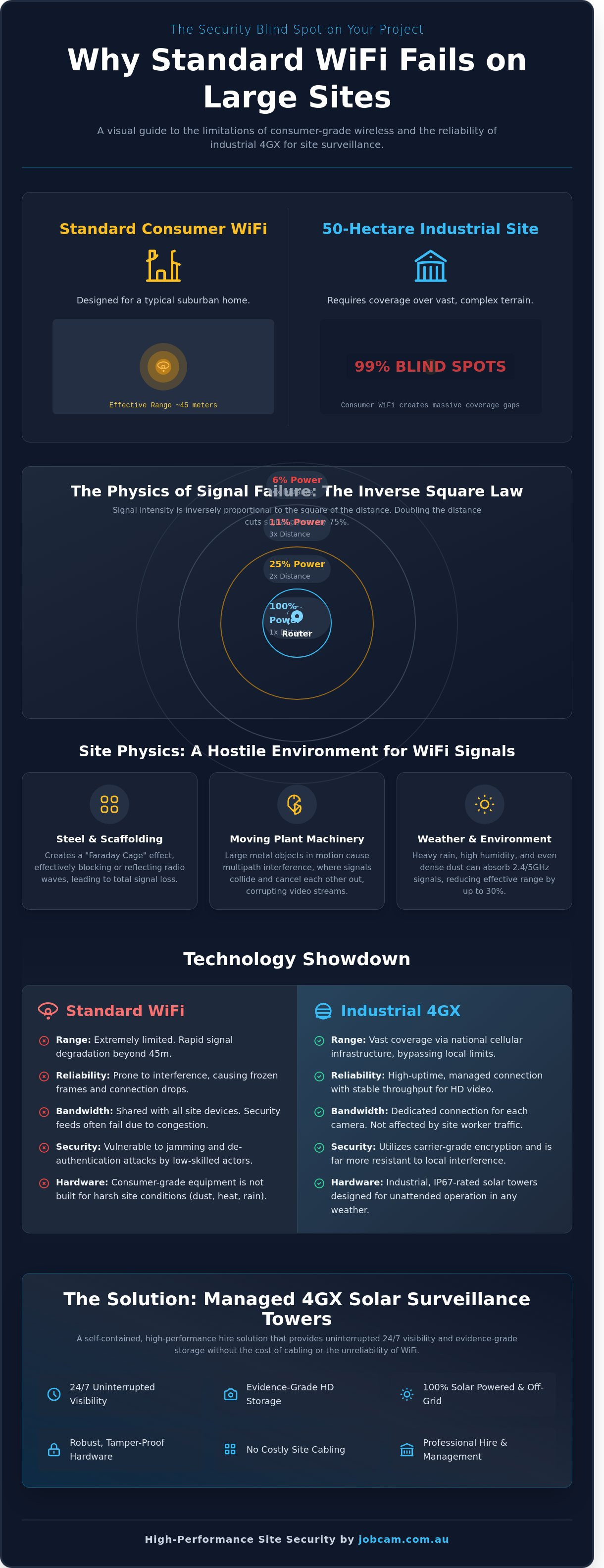
WiFi technology was engineered for static office environments, not the unpredictable terrain of a 5-hectare development project. While a 2.4GHz signal theoretically reaches 46 meters indoors, its performance on an open construction site is governed by the Inverse Square Law. This physical principle dictates that signal intensity is inversely proportional to the square of the distance from the source. If you double the distance from an access point, you receive only 25% of the original power. This rapid degradation is one of the primary problems with wifi security cameras on large sites.
Many project managers mistake signal indicators on a smartphone for connection quality. Seeing "full bars" does not guarantee a stable 8 Mbps stream. Video requires consistent, high-volume throughput, whereas a phone only needs periodic bursts of data for emails or browsing. Relying on standard site WiFi often results in critical footage gaps during high-stakes incidents. For reliable coverage, solar site cameras offer a self-contained alternative that bypasses these local network dependencies entirely. Our hire model ensures you have dedicated connectivity without the range limitations of a fixed router.
The Myth of the WiFi Range Extender
Extenders and consumer-grade mesh systems often create more logistical headaches than they solve. Most extenders operate on a half-duplex basis. This means they cannot send and receive data simultaneously, which immediately halves your available bandwidth at the first hop. Daisy-chaining nodes across a large perimeter introduces 15 to 30 milliseconds of latency at every connection point. In outdoor environments, consumer hardware lacks the IP67 rating required to survive 40-degree heat or heavy dust. When these components fail, your entire security perimeter goes dark.
Bandwidth Bottlenecks in High-Definition Streams
A single 4K security feed requires between 8 and 25 Mbps of constant upload speed to remain useful for evidence. When a site attempts to run five or ten cameras on a shared access point, the data load quickly exceeds 150 Mbps. This congestion leads to packet loss, causing frozen frames and pixelation that renders the footage useless for identification. Maintaining modern Wireless security protocols like WPA3 also adds processing overhead to the hardware. When 50 subcontractors connect their devices to the same network, the security feed is usually the first service to fail. Choosing temporary site security cameras for hire allows you to deploy independent units that don't compete for site bandwidth.
Site Physics: Why Construction Environments Kill WiFi Signals
Large scale development sites are inherently hostile to radio frequencies. Standard WiFi routers designed for static environments fail when faced with the dense structural elements of a 20,000 square meter project. This physical reality is the primary driver behind the problems with wifi security cameras on large sites. Radio waves require clear paths, but construction creates a constantly evolving maze of obstructions that absorb, reflect, and distort signals.
Steel reinforcement and scaffolding are particularly problematic. When metal mesh is spaced closely together, it creates a "Faraday Cage" effect. This physical phenomenon blocks electromagnetic fields, effectively trapping signals inside or reflecting them away from the receiver. Even a high-gain antenna struggles to penetrate a building once the structural steel is tied and the scaffolding is erected. Signals bounce off these metal surfaces, leading to multipath interference. This occurs when the same signal reaches the camera at slightly different times, causing data packets to collide and video streams to drop.
Atmospheric conditions also play a role in signal degradation. High humidity or heavy rain can absorb 2.4GHz and 5GHz frequencies, reducing the effective range of a wireless bridge by up to 30 percent during a storm. While physical barriers are a natural site challenge, intentional interference is a serious regulatory matter. The FCC notice on Wi-Fi blocking outlines the legal implications of disrupting wireless communications, yet the sheer volume of metal on a site often creates unintentional "blocking" that is just as effective at killing a connection.
Material Interference and Signal Absorption
Different materials impact signal strength with varying levels of severity. On an active site, you can rank signal-blocking properties as follows:
- Reinforced Concrete: The highest level of absorption; a 200mm slab can reduce signal by 20dB.
- Metal Sheeting and Foil Insulation: Reflects signals entirely, creating massive dead zones.
- Low-E Glass: Contains metal oxides that significantly dampen high-frequency waves.
- Timber and Drywall: Moderate interference, though still cumulative over long distances.
It's common for a camera to work perfectly during the excavation phase but fail entirely as the building rises. Attenuation is the gradual loss of signal intensity as it passes through physical matter or travels over distance on a job site.
Dynamic Obstacles on Active Job Sites
Construction sites are fluid environments where the topography changes daily. A 12-meter shipping container dropped in a new location can instantly sever a signal path that was clear 24 hours prior. Similarly, temporary fencing and heavy plant machinery moving between the camera and the router create intermittent dropouts that are difficult to troubleshoot.
Cranes and hoists present a unique challenge. As these massive metal structures rotate, they intermittently break the line-of-sight required for wireless bridges. Managing this "ever-changing" landscape is nearly impossible with fixed WiFi infrastructure. To maintain constant visibility without the headache of signal loss, many project managers opt to hire solar site cameras that operate independently of local network constraints.
Security Vulnerabilities and Reliability Risks of Site WiFi
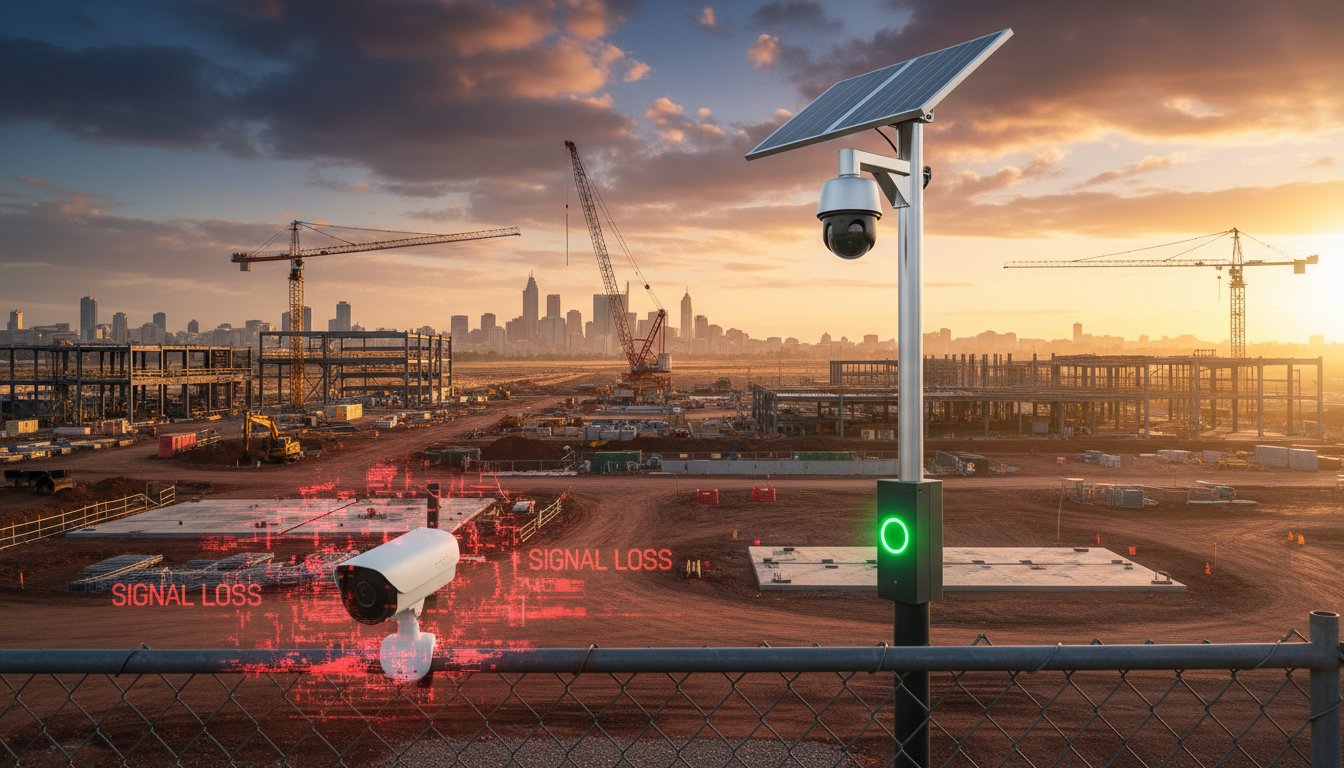
WiFi signals are inherently fragile in high-stakes industrial environments. Criminals often use portable signal jammers, which are available for under $100 on various grey markets, to flood the 2.4GHz frequency. This interference renders standard wireless cameras blind within seconds. These devices don't just weaken the signal; they completely sever the connection between the camera and the recording device. Research published by IEEE Xplore highlights how construction materials affect Wi-Fi, proving that dense materials like reinforced concrete and steel exacerbate these connectivity drops. This environmental interference is one of the primary problems with wifi security cameras on large sites where signal consistency is non-negotiable.
De-authentication attacks pose another severe risk to site security. Using simple software scripts, an intruder can send "disassociate" frames to your cameras. This forces the hardware to drop its connection to the network repeatedly. Because many consumer-grade wireless protocols lack robust management frame protection, the camera spends its time trying to reconnect rather than recording footage. Relying on a central router also creates a single point of failure. If the main power to that router is cut or the hardware fails, the entire surveillance network goes dark instantly. This lack of redundancy is unacceptable for professional project management.
Cybersecurity at the Perimeter
Hiding an SSID is a common but ineffective tactic that offers no real protection against professional intruders. Tools like Kismet or Aircrack-ng can identify "hidden" networks in less than 60 seconds by sniffing packet headers. Many project managers also overlook default credentials. A 2022 industry audit found that 15% of breached industrial IoT devices still used factory-set passwords like "admin123." JobCam mitigates these risks by utilizing secure AWS servers for data management. Our solar-powered camera towers don't rely on vulnerable local WiFi networks, ensuring that your site data is encrypted and stored in a professional cloud environment from the moment it's captured.
Physical Reliability and Data Loss
Local SD card storage is a major liability on active developments. If a camera is stolen or vandalized, the physical evidence disappears with the hardware. WiFi cameras also frequently fail to reconnect automatically after a power surge or a router reboot, requiring a manual site visit to reset the equipment. This downtime creates gaps in your project timeline and security logs. For reliable evidence, it's vital to have off-site cloud redundancy that stores footage independently of the physical unit. Our solar site cameras are designed for the hire market, providing a robust rental solution that avoids the technical pitfalls of ownership and local network dependency. We ensure your data remains accessible even if the physical unit is compromised.
Comparing Alternatives: 4GX vs. WiFi vs. Satellite
For organizations requiring even more specialized support with their broader digital frameworks, you can visit SolaaS LTD to discover flexible IT and telecommunications solutions tailored for business growth.
The Power of Telstra 4GX Connectivity
We utilize Telstra 4GX as the primary backhaul for our rental units. Unlike standard 4G, 4GX operates on the 700MHz spectrum. This lower frequency is a critical advantage for site managers. It penetrates physical obstacles like steel structures and concrete pilings much more effectively than higher-frequency 5GHz WiFi signals. This ensures a stable connection where standard consumer-grade gear would fail.
A hired 4GX tower provides a dedicated data link. It doesn't compete for bandwidth with site office staff, subcontractors, or guest networks. You get a clean, high-speed channel reserved exclusively for your high-definition footage. This isolation prevents the lag and packet loss that typically plague shared WiFi environments on busy projects. It's about maintaining a constant, reliable stream without the interference of local site traffic.
Infrastructure-Free Surveillance
The logistical nightmare of trenching for data cables or power lines can stall a project for weeks. Our solar-powered rental model eliminates this requirement entirely. These towers are fully self-contained units that arrive ready for immediate deployment. You don't need a licensed electrician or a network engineer to get eyes on your site. This "plug and play" capability is essential for fast-moving developments.
- Rapid Mobility: Move the tower to a new vantage point in under 15 minutes as your site footprint evolves.
- Zero Trenching: Avoid the high costs and safety risks associated with underground cabling and permanent power.
- Instant Deployment: Solar autonomy means the system works the moment it is positioned, even in zero-infrastructure zones.
Ensure your project stays on track with reliable, remote visibility. Explore our solar camera tower hire options to secure your site today.
The Jobcam Solution: Managed Solar Surveillance for Large Sites
Standard consumer hardware fails when it faces the logistical hurdles of a 50-hectare development or a multi-stage infrastructure project. The problems with wifi security cameras on large sites are effectively eliminated by moving away from ownership and toward a managed hire model. Jobcam provides high-performance Solar Security Cameras and mobile Surveillance Towers built specifically for rapid deployment in areas without fixed power or internet. We don't sell cameras or NVRs; we provide a complete surveillance service. This hire model includes professional delivery, site-specific installation, and ongoing technical support, ensuring your security remains operational without taxing your internal resources.
Monitoring is handled through the proprietary Jobcam Mobile App. It's a professional-grade tool that allows project managers to track site activity from any location. The app provides a seamless interface for live viewing and footage retrieval, removing the lag and connectivity drops common in unmanaged systems. To ensure maximum reliability, all footage is integrated with AWS cloud storage. This creates a tamper-proof digital trail. Even if a unit is targeted by on-site vandalism, your data remains secure and accessible in the cloud. It's a robust solution for maintaining 24/7 accountability across expansive perimeters.
Engineered for the Australian Environment
Australian job sites are brutal on electronics. Dust, 45-degree heat, and constant vibration from heavy machinery destroy standard gear. Jobcam hardware is built to survive these grit-filled realities. We provide a 100% Australian-owned service with a national support network that understands local conditions. Our technicians manage the professional installation and will relocate your camera towers as the site footprint shifts. This flexibility is essential for large-scale developments where the "line of sight" changes as structures rise.
Accountability Through Time-Lapse and Live Feeds
Jobcam turns security footage into a high-value project management and marketing asset. High-definition time-lapse captures every stage of the build, providing a 100% visual record for stakeholder reporting. It's a tool for transparency. You can showcase project milestones to investors or use the live feed to verify sub-contractor arrivals and material deliveries. Our brand promise is simple: see your site from anywhere. This capability reduces the need for constant site visits and provides absolute clarity on project progress.
Secure Your Perimeter Without the WiFi Bottleneck
Large-scale developments demand constant visibility that standard networking simply can't provide. Relying on local signals leads to blind spots and dropouts. The problems with wifi security cameras on large sites stem from physical barriers like concrete and steel that block signals beyond 30 to 50 meters. Jobcam eliminates these infrastructure hurdles by providing a managed solar surveillance rental service. We utilize the Telstra 4GX network and AWS-backed security to ensure your data remains protected and accessible at all times. Every hire agreement includes professional installation and relocation by our technicians; this keeps your project's security adaptive as the site footprint evolves. You can monitor progress in real-time through the Jobcam Mobile App from any location. This approach removes the burden of equipment ownership and maintenance from your team. Stop managing hardware and start overseeing your project with confidence. Our team ensures your site stays visible while you focus on hitting your construction milestones.
Get a fast quote for solar security camera hire
We look forward to helping you document your next successful project.
Frequently Asked Questions
Why do my WiFi cameras keep disconnecting on my construction site?
WiFi cameras disconnect because signal strength drops by 50 percent for every 10 meters of distance through building materials. Large sites feature steel reinforcement and concrete walls that block the 2.4GHz frequency. Hiring a solar tower with 4G connectivity bypasses these local interference issues entirely. It ensures your stream stays active without relying on a fragile local router.
Can I use a WiFi range extender to cover a large building site?
Range extenders aren't suitable for industrial sites because they cut bandwidth in half and add latency. A 100 meter site requires a mesh network that often fails in harsh outdoor environments. Our rental solar towers use independent cellular uplinks. This provides a stable connection without the need for expensive or unreliable site-wide network infrastructure.
Is 4G or WiFi better for remote site security cameras?
4G connectivity is the standard for large scale projects due to its reliability and range. While WiFi struggles with problems with wifi security cameras on large sites such as packet loss over distance, 4G towers provide consistent 10Mbps to 20Mbps upload speeds. This eliminates the need for IT staff to maintain a network across the entire project footprint.
What happens to my security footage if the camera is stolen or damaged?
Footage is transmitted instantly to secure cloud storage for immediate review. If a tower's tampered with, the last 30 seconds of high definition video remains accessible on our platform. This provides clear evidence for police reports. Since you hire the equipment, we manage the replacement process, which reduces your capital risk compared to owning hardware.
Do solar security cameras work on cloudy days or during winter?
Our solar towers include battery reserves designed to last for 5 consecutive days of zero sunlight. In regions like Melbourne, which averages 46 percent cloud cover, these systems still generate enough power to maintain 24/7 monitoring. The high efficiency panels charge the system even in ambient light conditions during the shortest winter days.
Are wireless security cameras easy to hack on a public WiFi network?
Public WiFi networks lack the enterprise grade encryption required for professional site security. Hackers can intercept unencrypted streams in under 10 minutes using basic software. Our hired towers utilize private APNs and end to end encryption over cellular networks. This ensures your site data stays private and protected from unauthorized external access.
How much data does a 4G security camera use per month?
Data usage typically ranges between 20GB and 60GB per month for a standard high definition stream. This varies based on how often you view the live feed or how many motion alerts are triggered. We include managed data plans in our hire agreements. You don't have to worry about managing SIM cards or paying unexpected overage charges.
Can I move my security cameras as the construction project progresses?
Mobility is a core benefit of the hire model. You can relocate a solar tower in under 20 minutes using a forklift as your site layout changes. This flexibility solves many problems with wifi security cameras on large sites where fixed wiring limits your visibility. Our units are designed for rapid redeployment across 50 hectare developments.