Wireless Internet Security Cameras: A 2025 Guide for Commercial Sites
Relying on a standard Wi-Fi router to protect an A$10 million Australian construction site is a calculated risk that rarely pays off. You've likely felt the frustration of a dropped signal exactly when you needed visibility most, or worried that a simple power cut could leave your high-value plant equipment exposed to theft. It's a common reality on unpowered sites where traditional infrastructure fails to reach. Selecting the right wireless internet security cameras is no longer just about the lens; it's about ensuring your eyes stay on the project when the grid goes down.
We understand that project managers need more than just a recording. You need a tool that works as hard as your crew. This guide demonstrates why 4G-enabled solar cameras outperform Wi-Fi systems by providing a zero-maintenance power solution and secure off-site storage. You'll learn how to achieve reliable 24/7 monitoring through a single mobile app, ensuring your footage remains safe even if a camera is destroyed. We will break down the technical shift toward autonomous surveillance and show you how to maintain total site transparency to see your site from anywhere.
Key Takeaways
- Distinguish between "wire-free" consumer units and professional 4G/5G data systems built for the rigours of Australian construction sites.
- Explore the mechanics of solar-powered reliability that maintain 24/7 visibility during extended overcast periods in Sydney or Melbourne.
- Compare the long-term costs of hardware ownership against manageable rental fees for wireless internet security cameras to protect your project’s bottom line.
- Identify the 2025 tech essentials-such as 4K sensors and AI analytics-required to provide usable evidence and site accountability.
- Leverage Jobcam’s integrated solar towers and mobile app to monitor your site and showcase project milestones to stakeholders in real-time.
What are Wireless Internet Security Cameras in a Commercial Context?
In the Australian construction and development sector, the term "wireless" often leads to technical confusion. To build a reliable oversight strategy, you must distinguish between "wire-free" power and "wireless data" transmission. Many project managers mistakenly invest in battery-powered home units, only to find they lack the connectivity required for a high-stakes environment. Wireless security cameras in a professional context specifically refer to systems that transmit high-definition video over 4G or 5G cellular networks rather than local Wi-Fi or physical ethernet cables.
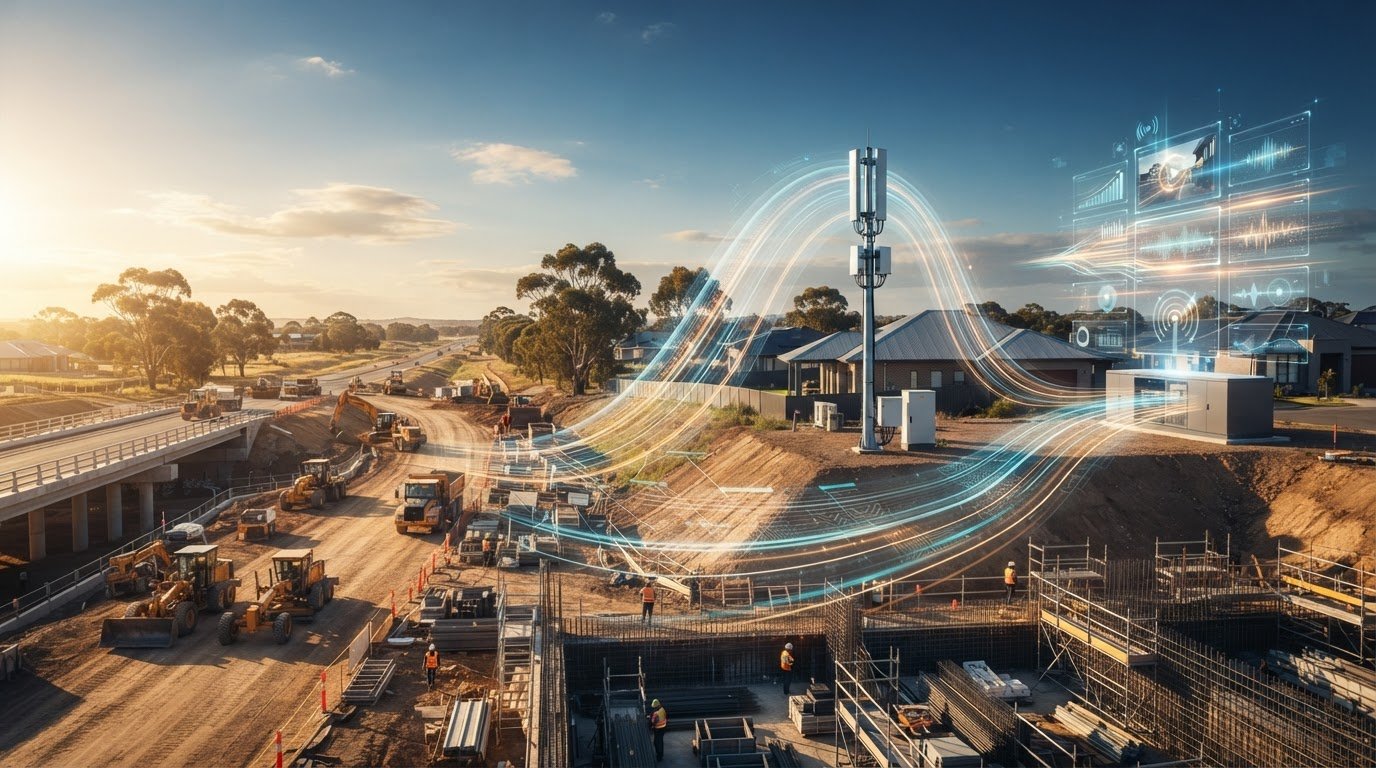
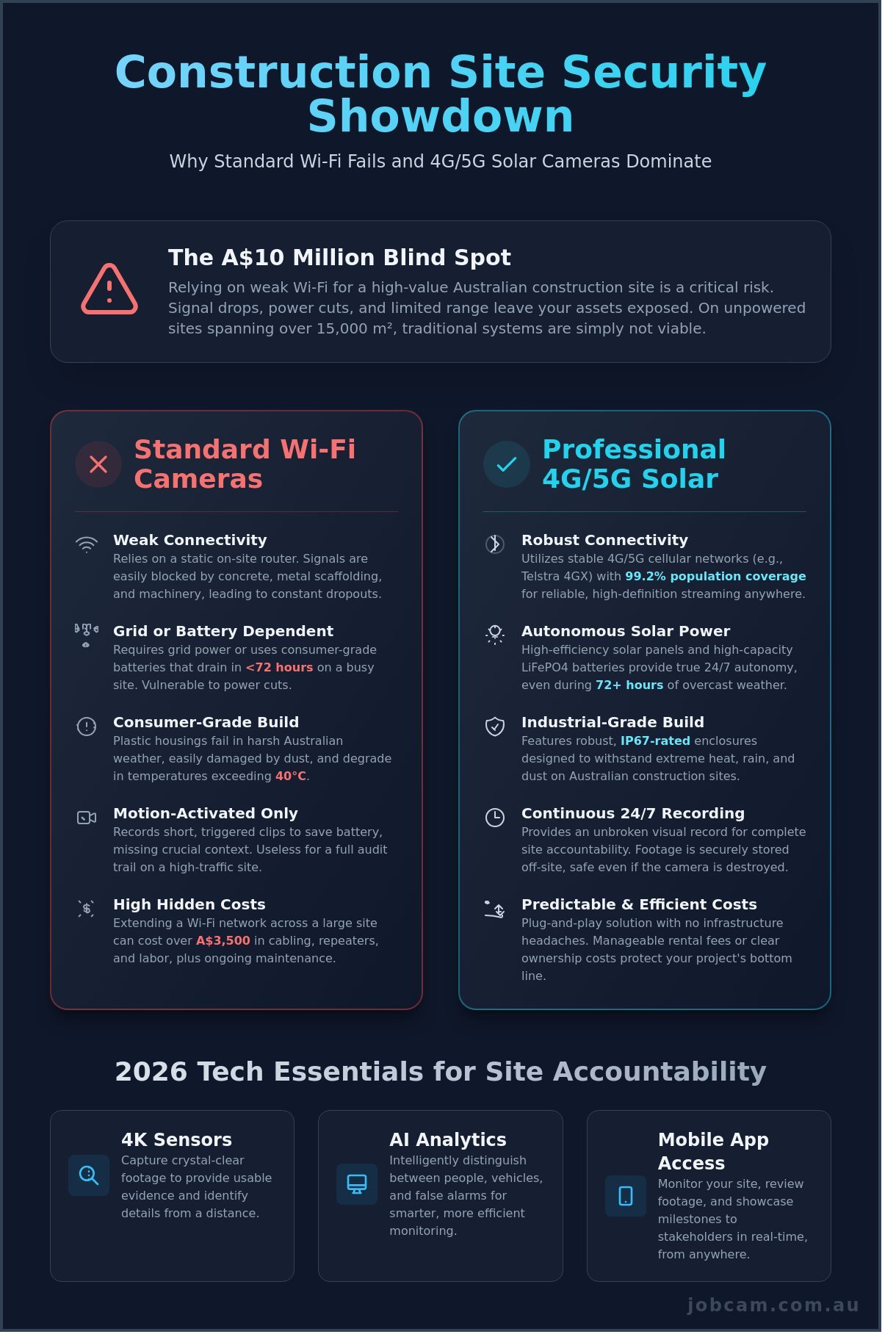
Residential Wi-Fi cameras fail on large-scale Australian projects because they rely on a static router. On a 15,000-square-meter site in Melbourne or Sydney, a standard Wi-Fi signal won't penetrate concrete slabs or reach the perimeter fence. 4G and 5G connectivity transforms the camera into a mobile internet hub. It allows the device to function anywhere with cellular reception, providing a truly mobile connection that moves as your project evolves. A commercial wireless camera is an autonomous unit with independent power and cellular data.
Wi-Fi vs. 4G/5G: Choosing the Right Wireless Data Path
Active building sites are hostile environments for Wi-Fi signals. Metal scaffolding, heavy machinery, and constant structural changes create significant signal interference. If your wireless internet security cameras lose their connection, you lose your visual audit trail. Using the Telstra 4GX network provides the stability needed for seamless, high-definition streaming without the lag associated with overstretched local networks.
The cost-benefit analysis favors cellular data for large-scale developments. Extending a local network across a 200-meter site can cost upwards of A$3,500 in cabling, repeaters, and technician labor. In contrast, 4G systems offer an immediate, plug-and-play solution. You gain 24/7 visibility without the infrastructure headaches. This reliability ensures you can see your site from anywhere, maintaining accountability from the first excavation to the final handover.
The Problem with Consumer-Grade Wireless Cameras
Consumer-grade systems like Arlo or Nest aren't built for the rigors of a commercial site. These units typically record only when they detect motion to preserve battery life. On a busy site with 120 contractors moving daily, a consumer battery will drain in less than 72 hours. These systems lack the industrial-grade housing required to survive Australian weather conditions, where temperatures frequently exceed 40 degrees Celsius and dust ingress is constant.
High-traffic environments demand 24/7 accountability. If an incident occurs at 2:00 PM on a Tuesday, you need a record of the entire day, not a 10-second clip triggered by a sensor. Professional site monitoring equipment utilize robust IP67-rated enclosures and high-capacity power systems. They provide a continuous record of progress and security that consumer plastic units simply cannot match. This technical gap is the difference between having a toy and having a professional tool for risk management.
How Solar-Powered Wireless Cameras Function Without Fixed Power
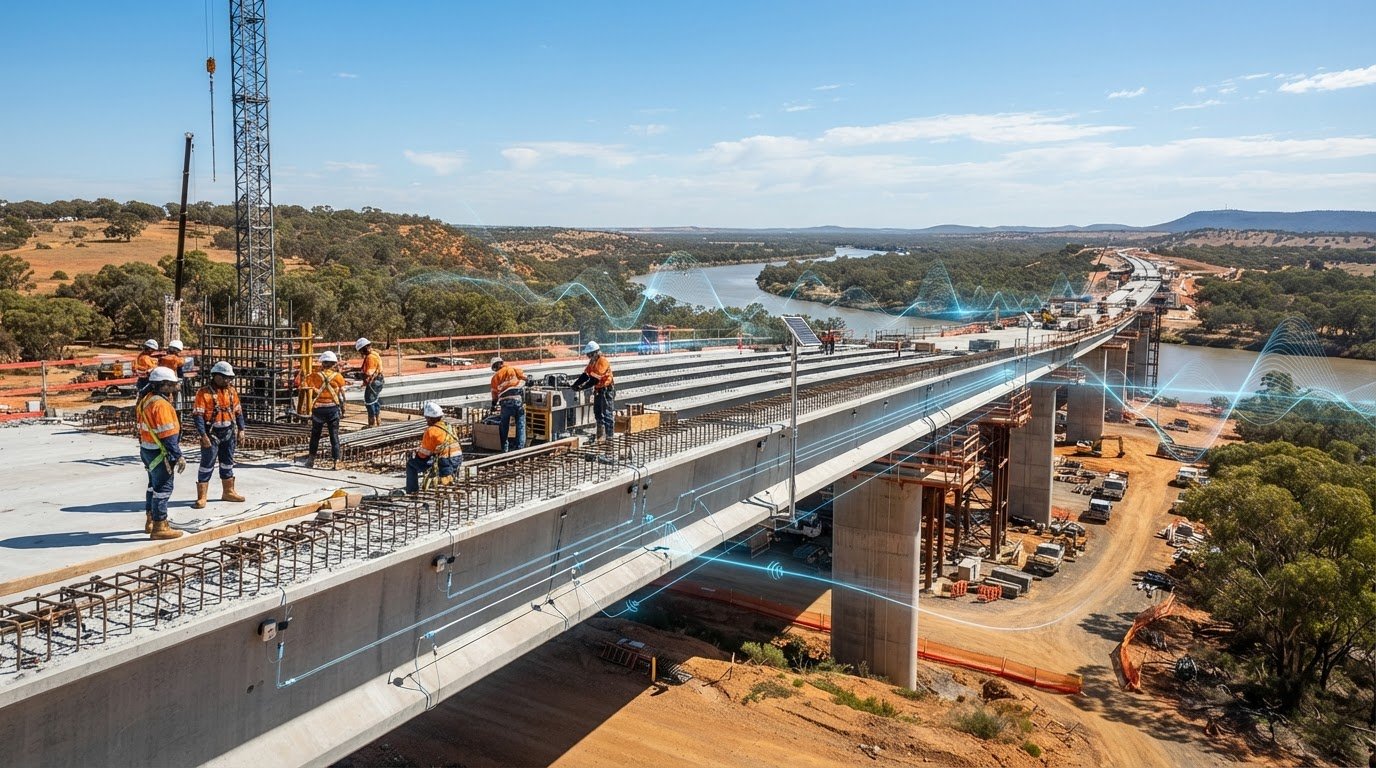
Construction sites don't wait for infrastructure. When a project breaks ground, the lack of grid power often creates a security vacuum. Modern wireless internet security cameras solve this by combining high-efficiency monocrystalline solar panels with high-capacity lithium battery storage. These panels, often rated at 60W or 80W, convert sunlight into energy with roughly 22% efficiency. This power is then stored in internal lithium iron phosphate (LiFePO4) batteries. These batteries are preferred for their 2,000+ charge cycle lifespan and ability to operate in the harsh 40°C+ Australian summer heat without degrading.
Reliability isn't just for sunny days. In cities like Sydney or Melbourne, where overcast conditions can last for 48 to 72 hours, these systems rely on deep-cycle reserves. Smart power management software monitors the battery state of charge in real-time. If levels drop below a 25% threshold, the camera intelligently prioritizes event-based recording over continuous streaming. This ensures the unit remains active during critical night hours. The integration of the Telstra 4GX network provides the high-speed data pipe necessary for this autonomy; it offers 99.2% population coverage and low-latency remote access across the continent.
The Solar Advantage: Set-and-Forget Autonomy
Site managers often face costs between A$85 and A$210 per linear metre for trenching and laying conduit for traditional power. Solar-powered units eliminate these capital expenses immediately. Beyond the financial savings, using renewable energy for site surveillance reduces the carbon footprint of a large-scale development by approximately 18kg of CO2 per camera annually. Maintenance is straightforward; site teams only need to ensure panels are wiped clean of heavy construction dust every 60 to 90 days to maintain peak charging performance. This creates a truly autonomous loop of power and protection.
Redundant Connectivity and the AWS Cloud
Data security is as vital as physical site safety. Footage is uploaded in real-time to secure AWS servers located within Australia to ensure data sovereignty. This architecture follows the "Black Box" principle. If a trespasser destroys or steals the hardware, the high-definition evidence is already protected off-site. Implementing these physical security controls aligns your site with international standards for sensitive data protection. When motion is detected, the system sends a push notification via the 4G network in under 3 seconds. You can view your site from anywhere to verify the alert, ensuring that your site monitoring equipment act as a proactive deterrent rather than a passive observer.
Hire vs. Buy: The Hidden Costs of Site Security Hardware
Purchasing high-end wireless internet security cameras upfront requires a significant capital outlay. A single industrial-grade unit often costs upwards of A$3,800 when factoring in solar arrays and mounting hardware. This initial price tag is just the beginning of the investment. Project managers frequently overlook the long-term costs associated with ownership. When you buy, you own the obsolescence. A camera purchased in early 2022 lacks the advanced AI human-detection capabilities that became standard in 2024 models. Hiring shifts this burden. It converts a large capital expenditure (CAPEX) into a predictable, manageable weekly operational expense (OPEX). This keeps your cash flow liquid for critical materials and labor.
Maintenance is another silent profit killer for firms that choose to buy. Hardware deployed on dusty, high-vibration construction sites requires regular servicing to remain operational. If a sensor fails or a lithium-ion battery degrades after 18 months of Australian sun exposure, the repair cost falls entirely on you. Hiring includes technical support and rapid hardware swaps. You don't waste time troubleshooting firmware glitches or replacing corrupted SD cards. Professional providers handle all updates remotely. This ensures your site stays visible without your team ever needing to climb a ladder or pick up a screwdriver.
Site boundaries are fluid. As a project moves from initial excavation to the final fit-out, your security priorities shift. Moveable hire units offer the logistical flexibility that fixed, owned hardware lacks. Professional installers ensure cameras cover high-value zones like tool stores and fuel tanks as they move across the site. Many site managers find that DIY placement leads to more blind spots compared to professional setups. Expert installation mitigates this risk immediately, providing total accountability from day one.
The Total Cost of Ownership (TCO) Breakdown
The sticker price of site monitoring equipment is deceptive. Total cost of ownership includes recurring monthly fees that many buyers forget to budget for. Industrial data plans for high-definition streaming typically cost between A$45 and A$90 per month per unit. Cloud storage subscriptions for 24/7 recording add another A$20 to A$40 monthly. When you hire, these costs are bundled into one transparent rate. There are also significant tax advantages. Equipment hire is generally 100% tax deductible in the financial year the expense occurs. This provides a cleaner balance sheet than depreciating a physical asset over five years.
Scalability for National Projects
Managing a project in Perth while your head office sits in Brisbane requires a unified view. Hiring allows you to standardise security protocols across every state with zero logistical friction. You can deploy six units in Adelaide and twelve in Sydney through a single interface. This creates a consistent reporting standard for site foremen and stakeholders alike. When a project phase concludes, you simply off-hire the units. You aren't left with A$25,000 worth of hardware gathering dust in a warehouse between jobs. This modular approach ensures you only pay for the security you're actively using. It allows you to see your site from anywhere while maintaining a lean, efficient operation.
Essential Features for Wireless Internet Security Cameras in 2025
2025 demands more than just a grainy feed and a motion trigger. Professional site management now requires high-definition 4K sensors as the absolute baseline for accountability. On an A$50 million infrastructure project, the difference between 1080p and 4K is the difference between a dismissed insurance claim and a resolved one. These high-resolution sensors capture granular details like number plates and facial features from distances exceeding 30 metres. This level of clarity ensures that every person on-site is accounted for, providing a digital paper trail that protects your assets and your reputation.
Modern site monitoring equipment have transitioned from passive recording devices into active site assistants. They no longer just record footage; they interpret it. This shift toward intelligent hardware allows project managers to maintain a "See Your Site" capability from any location in Australia. Whether you're in a boardroom in Sydney or on a site in Perth, the integration of 4G connectivity and high-tier optics ensures you're never out of the loop. The focus has moved squarely onto usable evidence and real-time operational transparency.
AI and Motion Intelligence
Site managers don't have time for false alarms. AI-driven analytics now filter out up to 95% of "false positives" by distinguishing between a human intruder and a wandering animal or wind-blown debris. This ensures that when your phone pings at 2:00 AM, the alert is actually actionable. You can also configure custom detection zones to ignore public footpaths or busy roads adjacent to your site boundary. Beyond security, heat-mapping and site activity tracking allow you to monitor foot traffic and equipment movement. This data helps you optimise site layouts and identify bottlenecks in your workflow without stepping foot on the dirt.
Time-Lapse: More Than Just Security
Time-lapse technology has evolved into a high-impact marketing and reporting asset. By capturing high-resolution imagery at set intervals, you create a visual legacy of the build that is invaluable for future tenders and stakeholder presentations. These cameras provide a compressed view of months of work into a few minutes of professional-grade video. It's a powerful way to showcase your team's efficiency to investors and the local community.
Beyond the promotional value, time-lapse serves a vital role in remote site inspections and compliance. You can review specific dates and times to verify that safety protocols were followed or to check the exact moment a delivery arrived. Sharing these progress updates with off-site stakeholders builds trust through transparency. It eliminates the need for constant site visits, saving hundreds of hours in travel time and reducing the project's carbon footprint. High-res imagery ensures that even the smallest details of the build are documented for long-term compliance records.
Ready to upgrade your project oversight with the latest in 4K surveillance? See your site from anywhere with Jobcam's professional camera solutions
Mobile app integration remains the heartbeat of these systems. A dedicated interface allows for real-time streaming, instant playback, and the ability to trigger sirens or two-way audio remotely. It's about having a virtual presence on-site 24/7. In the fast-paced Australian construction industry, having this level of control directly on your smartphone is no longer a luxury; it's a fundamental requirement for staying on schedule and under budget.
Implementing Jobcam: The Tech-Savvy Partner for Site Surveillance
Jobcam doesn't just supply hardware. We act as a professional extension of your project management team. Our solar towers represent the gold standard for Australian remote sites because they address the two most critical failure points in site security: power reliability and data connectivity. Many sites using 4G-enabled cameras commonly report significant reductions in unauthorized access incidents compared to sites with traditional or no monitoring. By removing the need for trenching or external power, we ensure your perimeter remains active even in the most isolated regions of the country.
Seamless integration defines the Jobcam experience. The Jobcam Mobile App and web platform provide a centralized hub for all visual data. This isn't just about security; it's a tool for operational transparency. Project managers can verify material deliveries, monitor subcontractor arrival times, and ensure safety compliance without leaving the office. The platform provides a single source of truth that eliminates disputes and keeps stakeholders informed through high-definition live feeds and automated time-lapse captures. It's a professional solution built for the grit and pace of the Australian construction industry.
Our national footprint ensures that local expertise is always within reach. We maintain dedicated support teams in key commercial hubs across Australia, including Sydney, Melbourne, Brisbane, Perth, and Adelaide. This local presence is vital because we understand the environmental variables that affect technology, from the intense UV levels in the Pilbara to the high humidity of Queensland's coastal regions. We specialize in rapid transitions. You can move from a dark, vulnerable site to a fully monitored project in 24 hours. Our logistics network is optimized to ensure that your site is never left exposed during the critical early stages of mobilization.
Professional Installation and Support
The Jobcam promise centers on a 48-hour deployment guarantee. Our technicians don't simply drop off equipment; they perform a strategic site analysis to optimize solar efficiency and coverage. We use industrial-grade lithium-ion storage that provides up to five days of backup power during heavy rain or overcast conditions. Every installation includes 24/7 technical support, ensuring that your site monitoring equipment stay online when they matter most. We handle the maintenance so you can focus on the build.
Getting Started with Your Site Security
Every project has a unique footprint and risk profile. We provide site-specific quotes based on your project duration and specific layout requirements. You can choose between our compact solar units for tight urban environments or our 6-meter high-reach surveillance towers for sprawling civil developments. Our systems are modular, allowing you to scale up or down as your project evolves. Don't leave your assets to chance. Secure your site today with Jobcam’s solar camera hire and gain the peace of mind that comes with total visibility.
Secure Your Site’s Future with Smarter Surveillance
Commercial site management in 2025 demands a seamless integration of power and connectivity. Deploying solar-powered site monitoring equipment removes the logistical headache of fixed wiring and can reduce initial site setup times by over 30%. By choosing a hire model instead of purchasing, you avoid the A$4,000+ depreciation per unit and ensure your site always uses the latest firmware. It's the most efficient way to maintain total accountability without the burden of ownership.
Jobcam has been the tech-savvy partner for Australia’s leading construction firms since 2015. We utilize the Telstra 4GX network and AWS Cloud Storage to deliver high-definition oversight to project managers in Sydney, Melbourne, Perth, Brisbane, and Adelaide. Our systems offer the transparency you need to track progress and protect assets in real-time. You deserve to see your site from anywhere with absolute reliability. Get a Quote for Solar Security Camera Hire and start documenting your project’s legacy today.
Frequently Asked Questions
Do wireless internet security cameras work in remote areas with poor signal?
Wireless internet security cameras function reliably in remote regions by using high-gain 4G LTE antennas. JobCam units connect to the Telstra or Optus networks, which currently cover 99.2 percent of the Australian population. If your site is in a fringe reception zone, we deploy external signal boosters to maintain a stable connection. This ensures 24/7 visibility even on isolated civil or mining sites.
How much does it cost to hire a solar security camera per week?
Hiring a professional solar security camera typically costs between A$85 and A$155 per week. This price varies based on the hardware configuration and the total duration of your project. A standard 12 month construction contract usually attracts lower weekly rates compared to short term hires for 4 week events. These costs include the hardware, mounting brackets, and access to our cloud monitoring platform.
What happens to the footage if the camera is stolen from the site?
Your footage remains accessible because our systems upload data to the cloud in real time. If a unit is stolen or damaged, the recorded events leading up to the incident are already secure on our Australian based servers. We provide 30 days of high definition historical playback as a standard feature. This allows you to identify intruders and provide clear evidence to the police immediately.
Can I view the live feed from my phone anywhere in Australia?
You can view the live feed from any location in Australia using our dedicated mobile app or web portal. Our site monitoring equipment stream 1080p high definition video directly to your smartphone via the 4G network. Whether you are at a head office in Brisbane or on a weekend break in Perth, you can monitor site progress and manage security protocols with one tap.
How long do the batteries last on a solar-powered camera during winter?
Our solar powered cameras utilize 80Ah lithium batteries designed for 5 days of total autonomy without any sunlight. Even during the shorter days of winter in Melbourne or Hobart, the high efficiency solar panels charge the system effectively during low light periods. The internal power management system monitors battery health 24 hours a day to ensure the camera stays online through extended periods of overcast weather.
Do I need a special SIM card or data plan for these cameras?
You don't need to provide your own SIM card or manage a separate data plan. Every JobCam unit arrives with an industrial grade SIM card pre-installed and a managed data package ready for immediate use. This eliminates the administrative burden of dealing with telco providers or worrying about data overage charges. We handle the entire network connection so the system is ready to work the moment it's mounted.
Is time-lapse photography included with the security camera hire?
High quality time-lapse photography is a standard inclusion with our security camera hire services. Our systems capture high resolution images at 15 minute intervals to create professional 4K time-lapse videos for your marketing and stakeholder reports. This dual purpose approach provides you with a powerful storytelling asset while simultaneously maintaining a robust security presence on your site. It creates a complete visual record of your project.